
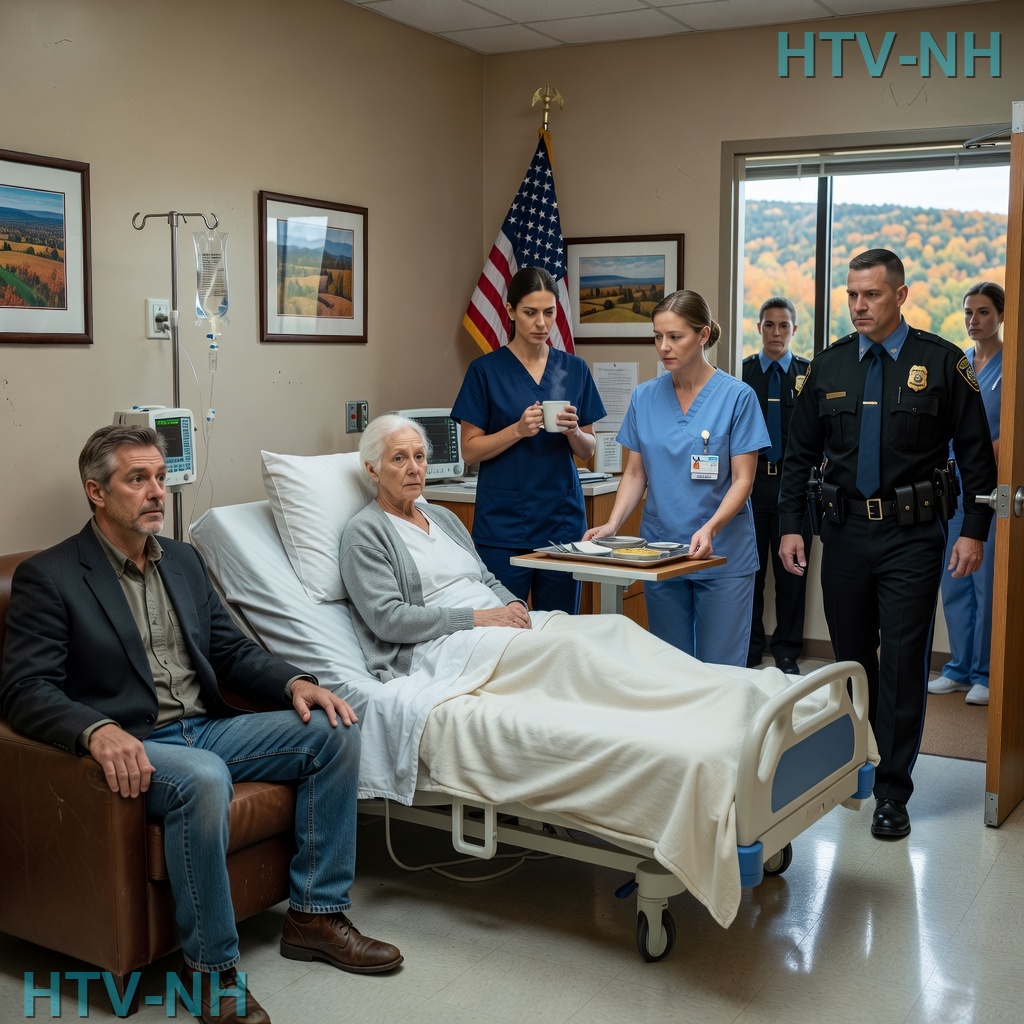
The institutional smell of bleach and boiled vegetables was suffocating, but it was nothing compared to the sickening performance happening right at the foot of my hospital bed.
My son, Julian, sat in the plastic visitor’s chair, leaning forward with an expression of intense, deeply practiced worry. Beside him stood his girlfriend, Chloe, her hands delicately folded, wearing the faint, sympathetic smile of a grieving angel. To any outsider walking past the glass doors of Room 412, they looked like the picture-perfect definition of devoted family members, keeping vigil over an ailing mother.
But I knew better. I had spent the last forty-eight hours watching the subtle, greedy glances they exchanged every time the doctor left the room. They weren’t waiting for my recovery. They were waiting for my signature.
“You need to eat your soup, Mom,” Julian said, his voice dripping with a bizarre, forced tenderness that made my skin crawl. “The lawyer said if you’re too weak, the notary won’t legally validate the power of attorney transfer tonight. We just want to take the burden of the estate off your shoulders.”
“Of course, darling,” I murmured, my hand trembling slightly as I lifted the plastic spoon to my lips. I kept my face entirely blank, masking the icy rage coursing through my veins. “I’m doing my best.”
Chloe smiled, her eyes gleaming with the triumph of a predator that believed its prey was completely cornered. They were utterly convinced that the heavy sedatives and the sterile environment had dulled my mind. They thought I was going to quietly sign away forty years of my life’s work before the sun went down.
————————————————————————————————————————
While I Ate Dinner in My Hospital Room, the Nurse Slipped Me a Note “Call 911”
My son, my own flesh and blood, sat in the chair beside my hospital bed, smiling. His girlfriend offered me a cup of tea. And just seconds before, the nurse had slipped me a note that made my blood run cold. It had only three words.
Call 911.
Before we continue, please subscribe to the channel and let us know where you are listening in the comments.
The scent of chicken soup should have been comforting. For seventy-six years, it had meant warmth, recovery, home. But here, in the sterile quiet of private room 512 at St. Bridget Medical Center, it smelled only of antiseptic and a cold, creeping fear. The steady beep of the heart monitor next to me was the only clock, marking time at 6:40 in the evening. Outside, the last of the October sun bled across the Maryland sky, painting the autumn leaves in hues of fire and gold. Inside, the world had shrunk to the white walls, the white sheets, and the polished steel of the dinner tray.
A young nurse named Tamsen Cole pushed the rolling table over my bed. She was efficient, her movements precise. She avoided my gaze, focusing instead on arranging the small bowl of soup, the plate of steamed vegetables, and the glass of water.
My son, Julian, looked up from his phone. He was forty-six, but tonight he looked older, the lines around his eyes etched deeper by worry—or so I had thought.
“Smells good, Mom,” he said, forcing a smile that didn’t quite reach his eyes. “You need to eat. Get your strength back.”
Beside him, his girlfriend Selene stood up. She was thirty-seven, with a sleek, polished look that always seemed out of place next to Julian’s rumpled exhaustion. She moved with a chilling grace.
“I’ll get you some tea, Aurelia,” she said. “Something to help you rest.”
I watched Tamsen as she adjusted the IV drip connected to my arm. As her hand brushed the side of the dinner tray, her fingers nudged something underneath it. It was a flicker of movement so small, so deliberate, that I knew it was meant only for me.
I held my breath.
She lifted the tray slightly to position it. And as she set it down, a small folded square of paper slid from beneath the metal rim and dropped silently onto the blanket covering my lap.
My heart hammered against my ribs, a frantic bird trapped in a cage.
Tamsen straightened up, her face a perfect mask of professional indifference. But just for a second, her eyes met mine. It wasn’t a look of pity or concern.
It was a warning.
Then she gave a nod so faint, so barely perceptible, it could have been a twitch. I felt a cold sweat break out on my forehead. My hand, hidden by the blanket, closed around the small piece of paper. The texture was rough, torn from a notepad.
Julian was talking again—something about the terrible Beltway traffic—his words a meaningless drone in the background.
Selene returned with a steaming mug, the fragrant scent of lavender filling the air.
“This herbal tea will help you sleep deeply tonight, Mom,” she said, her voice smooth as silk.
With my son and his girlfriend watching, I lifted the metal cloche from my soup bowl. The metallic clang echoed in the quiet room like an alarm bell. It was the only cover I had. My fingers fumbled with the note under the blanket. I unfolded it slowly, carefully, my eyes fixed on the soup as if it were the most fascinating thing in the world.
Then I read the words written in a hurried, slightly shaky hand. Three words printed in stark blue ink.
Call 911.
A wave of ice washed through my veins.
I looked up. Tamsen was at the door, about to leave. She didn’t look back. Julian was smiling that tired smile again. Selene was stirring the tea. And I, Aurelia Finch, suddenly felt like a prisoner.
A metallic taste flooded my mouth, sharp and bitter, even though I hadn’t eaten a thing.
The door clicked shut, and the silence Tamsen left behind was heavy, suffocating, and utterly terrifying. The note felt like a burning coal in my palm, hidden beneath the thin hospital blanket.
Call 911.
The words were seared into my mind. My gaze snapped from the closed door back to the two people in the room. My son and his girlfriend. One of them—or both of them—was the reason for that note.
Selene glided closer, holding the steaming mug.
“Here you go, Aurelia. Drink it while it’s warm.”
Her smile was perfectly crafted, a work of art, but her eyes were like polished stones.
“Thank you, dear,” I managed to say, my voice a dry rustle.
Julian shifted in his armchair, the leather groaning in protest.
“Drink it, Mom. Selene went to a lot of trouble. It’s that special blend you liked.”
I never liked lavender tea. I hated it. The scent was cloying. Arthur, my late husband, used to say it smelled like a dusty old drawer. I had never had it in my house.
My son—the boy I had raised for forty-six years—didn’t even know that.
Or maybe he did.
The thought sent another chill through me.
“I will,” I said, reaching for the mug with a hand I prayed wouldn’t betray its tremor. “Just let me catch my breath for a moment.”
“You need to relax,” Selene insisted, her voice dropping to a conspiratorial whisper. “The doctor said the most important thing for your recovery is deep, uninterrupted rest.”
She placed the mug on the rolling table, pushing it closer until it was right under my nose. The steam rose in a fragrant cloud, thick with the scent of lavender. But underneath it, there was something else—a faint, sharp tang. It reminded me of the taste of a penny held on the tongue, a smell like old tarnished copper.
Fear is a peculiar thing. It can paralyze you, turn your limbs to lead, or it can sharpen your senses until the world comes into focus with a terrifying clarity.
For thirty years as a public librarian, my job had been to bring order to chaos, to catalog, to cross-reference, to find the facts. My body was weak, but my mind, in that moment, slipped back into its old familiar rhythm.
I looked at the clock on the wall. The long red second hand swept past the twelve.
7:05 in the evening.
Item: One mug, ceramic, white.
Contents: Herbal tea. Lavender-scented.
Presented by: Selene Ward.
Witness: Julian Finch.
Action: Urged upon patient.
My mind was a catalog card, and I was filling in the blanks.
I had to play this exactly right. One wrong move, one sign of suspicion, and whatever game they were playing could escalate.
“You’re right,” I said, my voice steadier now.
I wrapped my hands around the warm ceramic, letting the heat seep into my cold fingers. I looked at Julian.
“I am tired.”
“It’s been a long day, and that’s why we’re here, Mom,” he said, his expression softening into something that looked almost like genuine concern. “To make sure you’re taken care of.”
I raised the mug toward my lips. Their eyes were fixed on me. I could feel their collective gaze like a physical weight. I tilted the rim to my mouth, letting the hot liquid touch my bottom lip. It was sickeningly sweet.
I didn’t swallow.
I let a tiny bit enter my mouth, just enough to wet the inside of the cup and my lips. Then I pulled back, setting the mug down on the table with a decisive clink. I brought my napkin to my mouth and coughed—a small theatrical cough.
“Oh dear,” I said. “It’s a bit too hot. Went down the wrong pipe, I think.”
I wiped my lips, removing any trace of the tea.
“I’ll let it cool for a few minutes.”
Selene’s smile tightened by a fraction of an inch.
“Of course.”
Julian looked annoyed.
“Just be sure you drink it, Mom. It’s for your own good.”
I leaned back against the pillows, closing my eyes to feign weariness, but my mind was racing. The taste in my mouth was still there, sweet and vaguely metallic.
Poison wasn’t always a dramatic, violent affair. Sometimes it was quiet. Sometimes it came in a warm mug, offered by a smiling face.
I kept my breathing slow and even, listening to their small talk. They spoke of Julian’s latest tech venture, the one that was always on the verge of a breakthrough but never quite there. They talked about selling my house—my beautiful brick bungalow in Silver Spring—speaking of it in the past tense as if I were already gone. They called it unlocking equity and easing my burdens. Every word was a confirmation of the note’s grim warning.
After what felt like an eternity, they decided to leave. Julian bent down and kissed my forehead. His lips were cold.
“Get some sleep, Mom. We’ll be back in the morning to handle some of that paperwork.”
Selene just stood at the foot of the bed, watching me.
“Good night, Aurelia.”
I waited until their footsteps faded down the hall. I opened my eyes. The room felt immense and empty. I looked at the mug of tea, still sitting on the table—a silent threat.
Then I glanced toward the hallway. Through the crack of the door, I saw Tamsen pushing a cart at the far end of the corridor. She looked up, and for a single fleeting second, our eyes met again. She didn’t smile. She didn’t gesture.
She just held my gaze.
And in that silent shared moment, I understood. It wasn’t an accusation.
It was a confirmation.
I wasn’t going crazy. The danger was real.
And I was not alone.
I barely slept. The night was a long, dark corridor of half-dreams and waking fears, the steady beep of the monitor my only companion. I lay perfectly still, feigning a deep slumber. I was nowhere near. My ears strained to catch any sound from the hallway. Each time the floorboards creaked outside my door, my heart leaped into my throat.
The untouched mug of lavender tea sat on the rolling table like a monument to the previous evening’s terror.
By the time the first gray light of dawn filtered through the blinds, a cold resolve had settled deep in my bones. I was no longer just a patient. I was a librarian with a mystery to solve, and my own life was the overdue book.
The morning routine of the hospital began around me, a symphony of rattling carts and hushed voices. A different nurse—a cheerful woman whose name tag read Brenda—came in to take my vitals. She was all smiles and sunshine, and I answered her questions with a placid calm I did not feel.
She eyed the full mug of tea.
“Oh, you didn’t like the tea, hon?” she asked, her voice syrupy sweet.
“I’m afraid my stomach was a little unsettled last night,” I lied smoothly. “Perhaps just some water for now.”
She whisked the mug away without a second thought.
For a moment, I felt a pang of panic.
That was evidence.
But what could I have done? Ask her to have it tested for poison? They would have thought I was losing my mind.
Perhaps that was the point.
It was close to 9:00 in the morning when Tamsen Cole appeared. She was carrying a fresh pitcher of ice water, her expression as unreadable as it had been the night before. She didn’t speak of the note. She didn’t have to.
As she placed the pitcher on my table, her eyes darted to the empty space where the mug of tea had been. She then met my gaze, a flicker of a question in her dark eyes.
I gave a single, almost imperceptible shake of my head.
I didn’t drink it.
She gave a sharp, clinical nod in return.
Good.
The entire exchange lasted no more than three seconds, a silent conversation that solidified our fragile, unspoken alliance. She left as quietly as she had come.
My next visitor was the one I had been waiting for, the one I both dreaded and hoped for: Dr. Evan Reed.
He knocked softly on the door before entering, a stark contrast to Julian’s unannounced entrances. He was a man in his mid-fifties with kind eyes crinkling at the corners and a mane of silver hair that gave him a distinguished air. He had the textbook bedside manner, a calming presence that was meant to put patients at ease.
Today, I would not be put at ease.
Today, I would be a librarian reading between the lines.
“Good morning, Aurelia,” he said, his voice a warm baritone. “The night nurse’s report says you had a restful night.”
A lie, right from the start.
“As restful as can be expected, doctor,” I replied, keeping my tone neutral.
He pulled the visitor’s chair closer to my bed and sat down, leaning forward with his hands clasped between his knees. It was a posture of sincere attention.
“Any dizziness? Numbness? How is the headache?”
“It comes and goes. But doctor, there is something I wanted to ask you about.”
This was it. My opening.
I had to tread carefully. Walk on eggshells.
“The medication,” I said. “The pills I’m given in the evening to help me sleep. They feel different. Stronger.”
He listened intently. His brow furrowed in concentration.
“Stronger? How?”
“I feel so groggy in the morning. It’s a struggle to even think clearly. Last night, I felt almost disconnected from myself. It’s a very unsettling feeling.”
Dr. Reed nodded slowly, absorbing my words. He didn’t dismiss them. He didn’t tell me it was my imagination.
He stood up and walked over to the small counter where my chart was resting. He picked it up, flipping through the pages, his eyes scanning the orders.
This, I thought, is what an honest doctor does. He checks the facts.
“Well,” he said after a moment, closing the chart. “I do see a notation here. There was a slight increase in your sedative.”
My breath caught.
“There was? Why?”
He walked back to the chair, his expression one of patient understanding.
“Aurelia, a transient ischemic attack—even a mild one like yours—is a significant trauma to the body and the brain. Rest is the most critical component of your recovery. Absolute, deep rest.”
He paused, choosing his next words carefully.
“Your son Julian spoke with me yesterday. He and Miss Ward were extremely concerned. He said you seemed agitated, that you weren’t sleeping well, and he was worried you weren’t giving your body a chance to heal. He was quite insistent, actually—said he would do anything to make sure you got the rest you need.”
The explanation was a perfectly constructed maze, and I was lost in it. He was using Julian’s own words, his supposed concern, as the foundation for the medical decision. He made it sound logical. He made it sound like love. He made it sound like my son was a devoted caregiver, not a potential monster.
He took the wind right out of my sails.
“He’s worried sick about you, Aurelia,” Dr. Reed continued, his voice softening. “Frankly, in my line of work, it’s refreshing to see a family so involved. So many of my patients are all alone.”
I felt my suspicion begin to curdle into guilt.
Was it possible? Had I misread everything? Was Tamsen mistaken? Was the note just a misunderstanding—an overreaction from a young nurse?
My seventy-six years of life had taught me to trust professionals, to trust doctors. This man, with his calm demeanor and logical explanations, fit every image of a trustworthy physician I had ever held.
“So you authorized the change?” I asked, my voice small.
“I did,” he confirmed without hesitation. “Based on the family’s report of your condition and my own assessment that more rest would be beneficial.”
But he leaned in again, kind eyes looking directly into mine.
“Your comfort is my top priority. If the dose feels too strong, we can absolutely dial it back. We can try the lower dose again tonight and see how you do. How does that sound?”
He was giving me control. He was listening. He was being the perfect doctor.
Everything he said made perfect sense.
And yet the memory of that coppery taste—the memory of Selene’s cold smile—refused to fade.
“Yes, doctor,” I said quietly. “Thank you. I would appreciate that.”
“Of course,” he said, standing up and placing a reassuring hand on my shoulder. The warmth of his touch felt genuine. “You just focus on getting better. Don’t you worry about a thing. Julian, Miss Ward, the nurses, myself—we’re all here to take care of you. You’re in my care now, Aurelia. I’ll keep a close eye on everything.”
He gave my shoulder a final gentle squeeze, and then he was gone, leaving behind the scent of antiseptic soap and a profound, unnerving sense of confusion.
I stared at the closed door, my mind a whirlwind. He had answered every question, soothed every fear I had voiced. He had been logical, compassionate, and professional.
And I—a woman who had spent a lifetime reading people as easily as she read the spines of books—couldn’t decide if I had just spoken to my savior or to a wolf in sheep’s clothing.
For the first time, I felt a flicker of doubt about my own judgment.
And that, I realized, was perhaps the most dangerous feeling of all.
The day after my talk with Dr. Reed was a study in unsettling normalcy. Just as he promised, the evening sedative was lighter. I woke up feeling clearer, the heavy fog in my mind having receded to a thin mist.
Julian and Selene visited in the afternoon. They brought a crossword puzzle book and spoke of trivial things—the unseasonably warm weather, a new restaurant they wanted to try. They didn’t mention paperwork or my health. They were playing the part of a devoted family, and they were playing it well.
If it weren’t for the memory of that note, I might have believed them. I might have dismissed the whole affair as a bad dream.
But I couldn’t shake it.
Dr. Reed’s perfectly reasonable explanation replayed in my mind. Yet it felt too neat, too clean. It was like a book with a beautiful cover that had a single crucial page torn out. You could still read the story, but you knew something was missing.
That night, I couldn’t settle. Sleep felt less like a refuge and more like a surrender.
Around 10:00, I pressed the call button. When the night nurse—a young man I didn’t recognize—appeared, I told him I was feeling restless.
“My legs are so stiff,” I explained, putting a quiver in my voice. “Could you just help me into the wheelchair? I think a little roll down the hall might do me some good.”
He obliged, his movements gentle as he helped me from the bed into the chair. He wheeled me out into the main corridor, its polished floors reflecting the dim recessed lighting. It was the quiet time in the hospital, the space between the end of visiting hours and the deep hush of midnight. The air hummed with the soft whir of machinery.
“You just press the button if you need me,” the nurse said before disappearing back toward the main station.
I wheeled myself slowly, my hands clumsy on the large rubber grips. I passed darkened rooms, catching glimpses of sleeping forms.
I didn’t have a plan—only a vague, desperate hope that I might see Tamsen Cole. I needed to see her, to look into her eyes again and know that what I had experienced wasn’t a product of a post-stroke imagination.
I turned a corner into a less trafficked wing of the hospital where the administrative offices and labs were located. The corridor was empty. I was about to turn back, a wave of disappointment washing over me, when a door to a small supply closet opened just ahead.
Tamsen slipped out.
She looked both ways down the hall, her movement swift and furtive. When she saw me, she gave a sharp, urgent motion with her head, beckoning me forward.
My heart began to pound. I wheeled myself toward her, the soft whir of the chair’s wheels sounding deafeningly loud in the silence.
She guided me into a small, darkened alcove next to a large vending machine, a space hidden from the view of the main corridor. We were bathed in the machine’s cold artificial glow.
“We don’t have much time,” she whispered, her voice tight with tension.
She was holding her personal cell phone.
“I took a risk getting this. If they find out, I’m finished. You have to listen, and you have to understand.”
I just nodded, my mouth too dry to speak.
“Dr. Reed spoke to you yesterday morning, right?” she asked.
I nodded again.
“He was kind, reassuring.”
“Very,” I whispered. “He explained everything.”
“I’ll bet he did,” she said, her tone sharp with cynicism. “Now, I want you to see something. This is a screenshot from your EMR—your electronic medical record.”
She saw the confusion on my face.
“Think of it like the old card catalogs at your library, Mrs. Finch. Every time someone checks out a book, they have to sign the card. The EMR is the same. Every single time a doctor, a nurse, or anyone else opens your file, it leaves a digital footprint. It records who it was and the exact time they did it. It’s a trail.”
She held the phone out to me. The screen glowed in the darkness, a list of names and timestamps in a simple black font. My name, Aurelia Finch, was at the top.
She pointed a finger at a specific section of the screen.
“Look here,” she said, her voice dropping even lower. “Two nights ago—the night I gave you the note.”
I squinted at the tiny letters. I saw a list of nurses’ names at normal times.
Then I saw two entries that made the hair on my arms stand up.
Reed, E.M.D., 03:14.
Ward, S., admin, 16:22.
I murmured. “That’s 4:22 in the afternoon.”
“Exactly,” Tamsen affirmed. “Right before she and your son came to visit you for dinner. That login—Ward S—that’s Selene’s. She’s a part-time administrative assistant here. She used her own login to look at your medication list.”
My mind flashed back to Selene’s smooth confidence, her easy use of medical terms. Of course. She wasn’t just a girlfriend. She had a foot on the inside.
But it was the other name that made my stomach clench.
“Dr. Reed,” I breathed. “3:14 in the morning.”
I looked up at Tamsen, my voice pleading for a different explanation.
“He must be a very dedicated doctor. Maybe he couldn’t sleep and was reviewing his cases.”
Tamsen’s expression was grim.
“Doctors don’t do chart reviews at 3:00 in the morning unless there’s a code blue—an emergency. And believe me, Mrs. Finch, this floor was quiet as a tomb that night.”
She took a deep breath.
“But that’s not the worst part. He didn’t just look at your chart. That timestamp—03:14—is the exact moment he electronically signed the order to increase your sedative dose.”
The floor seemed to drop out from under me.
“But that can’t be right,” I stammered, my carefully constructed faith in him crumbling. “He told me he increased it yesterday after Julian expressed his concern.”
“I know what he told you,” Tamsen interrupted, her voice hard. “He lied. He and your son’s girlfriend looked at your file. Then, in the middle of the night, he secretly doubled your sedative dose. Then he came in here the next morning and fed you a perfectly crafted story about your son’s concern to cover his tracks.”
Her eyes held mine, steady and merciless.
“He’s not just in on it, Mrs. Finch. He’s the one making it happen.”
I stared at the glowing screen—the two names, the two timestamps. Reed. Ward. A doctor and an administrator. A conspiracy in plain sight, hidden in a column of data.
The kindness in Dr. Reed’s eyes, the warmth in his voice—it had all been a performance, a lie designed to make me doubt my own mind.
He hadn’t just prescribed a drug.
He had prescribed a reality for me—one where I was confused and everyone else was concerned.
The coldness I felt was no longer just fear.
It was a glacial rage, slowly beginning to form.
They hadn’t just underestimated me.
They had used my trust, my age, and my condition against me.
They thought they were dealing with a confused old woman.
They had forgotten they were dealing with a librarian, and I was about to start checking the facts on every single one of them.
Before we continue, please subscribe to the channel and let us know where you are listening in the comments.
The rage that took root in the alcove with Tamsen was a cold and quiet thing. It didn’t burn hot; it froze, solidifying my fear into a weapon.
I spent the next morning in a state of hyper-awareness, every sense on high alert. I was no longer a patient recovering from a stroke. I was a counterintelligence operative in enemy territory. My hospital room was the field, and my mind was the command center.
I was just waiting for the enemy to make a mistake.
Around 11 in the morning, Brenda—the cheerful day nurse—bustled in.
“Got a little something for you, hon?” she chirped.
She was carrying my handbag, the worn leather one. Arthur had given it to me for our fortieth anniversary.
“They finally sent your personal items up from the admissions safe. Figured you might want it.”
“Thank you, Brenda. That’s very thoughtful.”
She placed it on my bedside table.
After she left, I opened it. The familiar scent of old leather and peppermint filled my nostrils. Inside were the contents of my life in miniature: my wallet, my reading glasses, a half-finished roll of mints, my favorite fountain pen, and a small silver digital voice recorder no bigger than my thumb.
I had carried one for years, a habit from my library days—perfect for making quick notes or recording thoughts for the community newsletter.
I picked it up. Its cool metallic weight was a familiar comfort in my palm. I checked the battery.
Full.
I clicked the small button on the side. A tiny red light blinked once, then held steady.
It was ready.
I slipped it back into my purse and waited. I didn’t know what for, but I knew I had to be prepared to document everything.
My opportunity arrived just after noon, in the form of Selene.
She entered the room carrying a vase of flowers so large it almost obscured her face. They were stargazer lilies, a riot of pink and white, and their scent was overwhelming—a sweet, feral perfume that instantly filled every corner of the room, thick and cloying.
“Something to brighten the place up,” she announced, placing the glass vase on the table at the foot of my bed. The water inside was slightly murky.
“They bring so much life into a room, don’t you think?”
“They’re very fragrant,” I said.
The understatement of the century.
The smell was already giving me a headache.
Selene fussed with a few of the leaves.
“Oh, the water in this is a bit cloudy. That won’t do. The flowers will die faster. I’ll just pop down to the nurse’s station and get some fresh water for these. I’ll be right back.”
And just like that, she was gone.
The moment the door clicked shut, I moved. My body—which had felt so frail and unresponsive—now acted with a librarian’s focused efficiency. I swung my legs over the side of the bed, my bare feet hitting the cold linoleum floor.
I grabbed my purse, my fingers instantly finding the small silver recorder.
I moved to the vase.
My hands were shaking, but my purpose was firm.
The florist had wrapped the base of the vase in a decorative crinkling sheet of cellophane tied with a large silk ribbon. It was the perfect hiding place.
I gently pried open a fold in the cellophane at the back of the vase, away from the side that would face the room. I slipped the recorder inside, its smooth surface sliding against the crinkly plastic. I angled it so the tiny microphone was pointing upward and outward toward the small seating area where Julian and Selene usually sat.
Then I pressed the record button.
The tiny red light blinked once.
It was active.
I carefully pressed the cellophane back into place, smoothing it out. The entire operation took less than twenty seconds.
I heard footsteps in the hall—Julian’s voice.
I scrambled back into bed, pulling the thin blanket up to my chin, my heart hammering. I turned my head toward the window and closed my eyes, forcing my breathing to become slow and even, mimicking the light doze of a medicated patient.
The door opened.
“Selene said she was bringing flowers,” Julian’s voice said.
“I was just getting them fresh water,” Selene replied.
I heard the sound of the vase being placed back on the table. The soft clink of glass on wood.
“Look,” Selene murmured. “She’s asleep again. The new dose must still be keeping her nice and relaxed.”
“Good,” Julian said, his voice closer now.
I heard the familiar groan of the leather armchair as he sat down.
“We need her relaxed. We need her compliant.”
I kept my eyes shut. My entire being focused on listening. The cloying scent of the lilies was a constant, suffocating presence.
“Did you talk to your lawyer about the house?” Selene asked, her voice a low murmur.
“I did,” Julian confirmed. “He said as long as we have the power of attorney, we can list it.”
He called it a dead asset, just sitting there doing nothing.
“With the market in Silver Spring, we could have a check in our hands in less than two months. Enough to clear my tax debt and get the new venture off the ground.”
Dead asset.
He was talking about my home. The home I had shared with his father for fifty years. The home where I had raised him.
The words were like shards of glass in my ears.
Selene’s voice was sharp, practical.
“The house is one thing, Julian. The real prize is the brokerage account and the IRA. We can’t touch those without full durable POA. And for that to be ironclad, we need a physician sign-off on her declining cognitive state—one that will hold up in court if anyone challenges it.”
Julian’s voice dipped, anxious.
“Reed is on board, right?”
“Evan is completely on board,” Selene said.
Her use of Dr. Reed’s first name sent a jolt through me.
“He’s been documenting her confusion and mild paranoia since she was admitted. He told me yesterday that he’d be prepared to sign an affidavit stating that she’s no longer capable of managing her own financial affairs. He said—and I quote—‘It would be a medical necessity to protect her from herself.’”
Oh, the audacity of it. The cold, calculated cruelty took my breath away.
They weren’t just planning a theft.
They were building a cage of lies around me, using my own doctor as the blacksmith.
“So we get her to sign the papers in the next day or two,” Julian mused, sounding more confident. “While she’s still groggy and agreeable.”
“Exactly,” Selene said. “We push the new documents through, and once we have control, we can start the transfers. It’s all just a matter of following the process.”
I lay there perfectly still, a statue carved from rage.
The tiny device hidden in the cellophane was capturing it all—their whispers, their plans, their betrayal.
The sweet, sickly smell of the lilies filled my lungs.
They thought they were bringing flowers to a sick old woman.
They had no idea they were actually delivering the evidence for their own prosecution.
The digital recorder tucked safely back in my purse was both my shield and my burden. It held the truth, cold and undeniable, in its tiny memory.
I had the evidence. The logical, methodical part of my brain—the librarian part—knew exactly what the next steps should be. Follow the protocol. Present the evidence to the proper authorities.
The note had said to call 911.
For the first time, that felt like a tangible, achievable action.
But I was not just a librarian.
I was a seventy-six-year-old woman who had been taught her entire life to believe in certain pillars of society. And one of the strongest of those pillars was the authority and integrity of a doctor.
The recording in my purse was damning for Julian and Selene. Their guilt laid bare in their own whispered words. But for Dr. Reed, it was hearsay. It was Selene’s word against his reputation.
“Evan is completely on board,” she had said.
Was she telling the truth? Or was she a master manipulator, using the doctor’s name to add weight to her own wicked plans—perhaps even fooling Julian?
This sliver of doubt, this tiny maddening possibility that Dr. Reed was just another pawn in Selene’s game, became a splinter in my mind.
The librarian in me screamed that it was foolish hope, a distraction from the clear and present danger.
But the woman—the patient—who had looked into his kind eyes and heard his reasonable voice needed to be certain.
I needed to look him in the eye one more time before I took a step that would bring the whole world crashing down.
I needed to see for myself if he was a co-conspirator or just another victim.
It was a mistake. A foolish, emotional, dangerous mistake.
But it was one I felt I had to make.
That afternoon around 3:00, I pressed the call button. I didn’t ask for Brenda or any other nurse. I asked for him specifically.
“Could you please let Dr. Reed know that I’m feeling quite unwell?” I told the aide who answered. “I have a pounding headache and I’m seeing spots. I need to speak with him as soon as possible.”
It was a lie, but a medically plausible one for a stroke survivor.
It was also bait.
If he was innocent, he would come, concerned.
If he was guilty, he would come, alarmed that his plan might be going off the rails.
Either way, he would come.
Less than twenty minutes later, he was there. He entered my room with a look of professional gravity, my chart already in his hand.
“Aurelia? The nurse said you were having some visual disturbances?”
His voice was laced with concern. He immediately began checking the monitors, his movements efficient and practiced.
“It’s passed now,” I said, my voice intentionally weak. “But it was frightening. Doctor, could you please close the door?”
He hesitated for a fraction of a second, then complied, shutting the door until it clicked softly.
The room was suddenly an isolated capsule of silence, broken only by the rhythmic beeping of the machines.
“I’m very frightened, doctor,” I began, letting my voice tremble. I had to play my cards close to my chest. “I think…I think I’m becoming confused. I’m hearing things. Or maybe I’m not.”
He pulled the chair to my bedside, his face a perfect mask of sympathy.
“Aurelia, it’s very common after an event like this. The brain is healing. Sometimes signals get crossed. Tell me what’s bothering you.”
I took a deep breath.
“I was dozing earlier, when my son and his girlfriend were here, and I thought I heard them talking about…about paperwork, about my house, about needing you to sign something saying I wasn’t competent.”
I looked at him, my eyes wide with manufactured fear and confusion.
“That’s just a bad dream, isn’t it? A paranoid fantasy.”
I watched his face for a flicker, a crack in the facade.
There was nothing.
He just looked deeply, profoundly sad.
He reached out and gently took my hand, his grip warm and firm.
“Oh, Aurelia,” he said, his voice a low, sorrowful murmur. “I am so, so sorry you had to overhear that.”
My blood ran cold.
It was the one response I hadn’t expected.
Not denial.
Confirmation.
He saw the shock on my face and immediately began to backtrack, to reframe.
“Now, let’s not jump to conclusions. I’m sure they meant well. Your son—he is under a tremendous amount of stress. This new business of his, he’s in over his head. He’s terrified of losing you. And sometimes when people are scared, they do foolish things. They overreach.”
He was a masterful actor. He was painting a picture of Julian and Selene not as villains, but as misguided, overzealous caregivers. He was positioning himself as my protector, the reasonable adult in the room.
“They believe they are protecting you,” he continued, his thumb gently rubbing the back of my hand. “They have this idea that if they take control of your finances, they can remove all your stress so you can focus on healing. It’s a wrong-headed, misguided approach, of course. But I truly believe their hearts are in the right place.”
Every word was a perfectly polished lie designed to placate me, to make me doubt the evidence of my own ears.
“So…you knew about this?” I whispered.
“I knew they were concerned,” he said, choosing his words with surgical precision. “Selene mentioned that they were exploring options to help manage your affairs. I told her then that any such discussion was premature and that you—and you alone—were in charge of your own decisions.”
He looked me straight in the eye.
“And I stand by that one hundred percent.”
He was selling me a bill of goods, and he was doing it with an Academy Award-winning performance.
For a dizzying moment, he made me feel I had misjudged him completely—that he was on my side.
“Thank you, doctor,” I said, feeling a wave of genuine—if misplaced—relief. “I was so worried.”
“You have no reason to be,” he said, his voice firm and reassuring. “You are my patient, Aurelia. My responsibility. Let me handle this. I will have a very firm, very direct conversation with Julian and Selene. I will make it crystal clear that these pressure tactics are unacceptable and are detrimental to your health. I will put a stop to it. You have my word.”
He gave my hand a final reassuring squeeze, then stood up.
“Now you get some rest. Put this out of your mind. Let me be the bad guy. You are safe here. I will not let anyone harass you.”
He smiled—a warm, paternal smile—and walked out of the room, closing the door softly behind him.
I leaned back against the pillows, my mind a turbulent sea of confusion.
He had been so convincing.
Could it be true? Was he really going to protect me?
The hope was so seductive, so tempting.
And then, through the thin hospital door, I heard his footsteps stop just outside.
I heard the faint, muffled sound of his voice.
I couldn’t make out the words. Not at first. I held my breath, straining to listen.
The words became clearer.
His voice was no longer warm and sympathetic.
It was cold, sharp, and urgent.
He was on the phone.
“She knows,” he said, his voice a low hiss of venom. “I don’t know how, but she knows. The whole thing is about to blow up. Forget the plan. We have to move faster tonight.”
The door clicked shut, and the sound echoed in the room like a gunshot.
For a long moment, I didn’t move.
I couldn’t.
The warm, reassuring words Dr. Reed had spoken just minutes before were still hanging in the air, a phantom comfort that now felt like a shroud.
But they were drowned out by the echo of his final whispered words from the hallway.
“She knows. We have to move faster tonight.”
The hope he had so expertly manufactured in me shattered into a million pieces.
The floor didn’t just drop out from under me.
It evaporated.
I was in free fall, plummeting into a darkness so profound it felt absolute.
I had walked right into the lion’s den and politely asked the lion if he would be so kind as not to eat me.
I hadn’t just made a mistake.
I had handed my enemies a timetable.
Whatever they were planning—whatever final, irreversible step they intended to take—was now imminent.
Panic, cold and sharp, seized me. My first instinct was to scream, to press the call button and tell the first nurse I saw everything.
But who would come? A nurse who reported to Dr. Reed? An aide who saw me as a confused old woman?
They would sedate me.
They would say I was having a paranoid episode.
Dr. Reed himself had already laid the groundwork, documenting my confusion.
My own words would be twisted and used to lock the door behind me.
I was trapped.
Utterly and completely trapped.
My hand, trembling uncontrollably, crept under my pillow. My fingers brushed against the cool, smooth surface of my cell phone.
The note had said to call 911.
But what would I say?
My son and my doctor are trying to steal my money.
It sounded like the rambling of a lunatic.
I needed more than an accusation.
I needed a strategy.
I needed an ally outside these walls—someone whose world hadn’t been poisoned by Evan Reed’s influence.
My mind raced through a mental Rolodex of friends and neighbors. Good people, all of them.
But who would have the strength, the knowledge, the steel to fight this?
And then a name surfaced from the depths of my memory, a beacon in the fog.
Lydia Maro.
Lydia wasn’t just a friend from my Saturday morning book club.
She was a retired estate lawyer.
For forty years, she had navigated the murky waters of family disputes, wills, and trusts.
Lydia was sixty-two, sharp as a tack, and had a healthy disdain for fools and liars. She was a woman who read the fine print.
She was the only person I knew who wouldn’t just listen.
She would act.
My fingers, clumsy with fear, fumbled with the phone. I pulled up her contact number. It was late—close to 11:00 at night.
It didn’t matter.
I pressed the call button.
The phone rang once, twice, a lifetime stretching between each ring.
On the third ring, she answered.
“Maro,” she said, her voice crisp and alert, even at this hour.
“Lydia,” I breathed, my voice cracking, a desperate whisper. “It’s Aurelia Finch.”
“Aurelia? Good heavens, what’s wrong? You sound dreadful.”
The dam broke.
The words came tumbling out, a torrent of fear and confusion. I told her everything—starting with the note under the tray. My voice a frantic whisper as I recounted the lavender tea, the conversation with Tamsen in the hallway, the damning digital footprints on the EMR, the voice recorder hidden in the bouquet of feral lilies, and finally the horrifying confirmation from Dr. Reed’s own lips just outside my door.
Lydia didn’t interrupt.
She listened.
Her silence was a vast, absorbent space.
I could picture her on the other end, sitting in her leather armchair, a cup of tea growing cold beside her, her expression hardening with every word I spoke.
When I finally finished, my story hanging in the air between us, there was a long pause.
“Lydia, are you there?” I whispered, terrified she wouldn’t believe me.
When she finally spoke, her voice had changed.
The friendly warmth was gone, replaced by a cold, hard fury.
“That son of a—” she hissed. “And that two-faced, predatory son of a— in a white coat.”
The venom in her voice was more comforting to me than any words of sympathy.
She took a deep, steadying breath.
“Okay, Aurelia, listen to me now, and listen very carefully. You are in a great deal of danger, but you are not helpless. Arthur made sure of that.”
“Arthur?” I asked, confused. “What does my husband have to do with this?”
“Everything,” Lydia said, her voice now the embodiment of legal authority. “Do you remember about ten years ago when Julian’s first tech company went bankrupt? Arthur was worried. He came to see me. He loved his son, but he wasn’t blind. He saw the gambler in him—the desperation. He was afraid that if anything ever happened to him, Julian might one day put you in a vulnerable position.”
A memory surfaced—a vague recollection of a long afternoon spent in Lydia’s wood-paneled office, signing a thick stack of documents I hadn’t fully understood at the time.
“Arthur had me write a special provision into your trust,” Lydia continued. “It’s called a springing clause, but I want you to think of it as a firewall—or better yet, a dead man’s switch. He stipulated that if ever there was credible evidence—a doctor’s report, a police report, or a sworn affidavit—that you were being subjected to undue influence, duress, or chemical coercion, the trust would be triggered.”
“Triggered?” I asked.
“It means the walls come down,” Lydia explained, her voice sharp and clear. “Instantly. The moment I file the paperwork with the evidence, your primary asset accounts—the brokerage account, the IRA, everything—are automatically frozen. Julian is immediately and irrevocably removed as your successor trustee. All control of the assets is temporarily transferred to an independent third-party fiduciary until a court can determine your well-being. He couldn’t touch a single penny with a ten-foot pole.”
She didn’t soften it.
“Arthur built you a fortress, Aurelia, and those fools are about to run headfirst into the wall.”
Tears streamed down my face, hot and silent. They weren’t tears of fear anymore.
They were tears of gratitude—of overwhelming love for the man who had thought to protect me, even from beyond the grave.
Now Lydia’s voice snapped me back to the present.
“We have the evidence. The recording is our smoking gun. But we have to move flawlessly. You cannot call 911. Not yet. That creates chaos, and they could use it to have you declared mentally unstable. We need to do this by the book. We need to build a case so airtight it suffocates them.”
She paused.
“There is a man. His name is Owen Keading. He’s a patient advocate, but he’s more than that. He used to be a private investigator. He’s quiet. He’s methodical. And he knows hospital procedure and elder abuse law inside and out. He is the first official step. He will create the record we need.”
I heard the sound of a pen scratching on paper.
“I’m texting you his number right now. Your phone will vibrate. Do not look at it until we hang up. Here is what you are going to do. You are going to call him. You are going to tell him that your lawyer, Lydia Maro, told you to call and that you are in immediate danger. You will tell him everything you just told me. Do not talk to any nurses. Do not talk to your son. Do not drink or eat anything they give you. You wait for Owen Keading. Is that clear?”
“Yes,” I said.
My voice was no longer a whisper.
It was steady.
“Yes, Lydia. It’s clear.”
“Good,” she said. “Now hang up, Aurelia, and make the call. The fight starts now.”
After the call with Lydia ended, I sat in the darkness for a full minute, the phone clutched in my hand. The fortress Arthur had built for me had been revealed.
But it was up to me to raise the drawbridge.
The fear was still there—a cold knot in my stomach—but it was now overlaid with a new, unfamiliar sensation.
The thrill of the fight.
My phone vibrated once.
Owen Keading’s number.
I took a deep breath and dialed.
A man answered on the first ring, his voice low and gravelly, devoid of any emotion.
“Keading.”
“Mr. Keading,” I said. My voice was keyed but steady. “My name is Aurelia Finch. I’m a patient at St. Bridget Medical Center. Your name was given to me by my lawyer, Lydia Maro. She said I should tell you that I am in immediate danger.”
There was a pause on the other end, but it wasn’t a pause of disbelief.
It was the silence of a professional absorbing data.
“Room number,” he asked.
“512.”
“Don’t talk to anyone,” he said. “I’m on my way.”
The line went dead.
I hid my phone back under the pillow.
Waiting was the hardest part.
Every shadow in the room seemed to move. Every creak of the old hospital building sounded like an approaching footstep. I knew Julian and Selene could return at any moment.
Dr. Reed’s words—tonight—echoed in my mind.
An hour crawled by, then another.
It was past 1:00 in the morning.
I was about to give in to despair when my door opened a crack.
It wasn’t the imposing figure of Owen Keading I was expecting.
It was Tamsen Cole.
She put a finger to her lips and beckoned me with a quick, urgent gesture.
I didn’t hesitate.
I pushed myself out of bed, my body aching in protest, and slipped into the wheelchair I had used earlier. I wheeled myself silently into the hallway where she was waiting.
“This way,” she whispered, not looking at me, but leading the way down the corridor, her rubber-soled shoes making no sound.
She didn’t take me to an alcove this time.
She used a key card to open a door marked MEDICATION PREP—AUTHORIZED PERSONNEL ONLY.
She ushered me inside and closed the door behind us, locking it.
The room was small and smelled intensely of rubbing alcohol. It was lined with stainless steel counters and locked glass cabinets filled with drugs. The only light came from a small task lamp over a counter, casting long shadows.
Tamsen’s face was tense, her expression all business.
“You’re right to be afraid,” she said, her voice low and direct. “They’re escalating. I overheard a charge nurse saying Dr. Reed put in a request for an emergency psychiatric evaluation for you to be conducted first thing in the morning.”
The words hit me like a physical blow.
They were moving to have me declared incompetent.
“But they’ve gotten sloppy,” Tamsen continued, her focus absolute. “And I’ve been busy.”
She reached into a pocket of her scrubs and pulled out a clear sealed plastic bag. It was an official evidence bag, the kind I’d only ever seen in movies.
Inside were two small glass vials, the kind used for lab samples. Each was sealed with a rubber stopper and labeled with a pristine white sticker. The handwriting was neat, precise, and clinical.
She held the bag up under the light.
“This is the tea from two nights ago,” she said, pointing to the first vial.
The label read: Finch, A., room 512, sample A, October 12th, 19:05.
“And this,” she said, pointing to the second, “is from the night before that, when you told me you felt groggy.”
The label was identical except for the date.
“I kept them refrigerated. They’re untainted.”
I stared at the two vials, at the amber-colored liquid inside.
It was the physical manifestation of their betrayal—cataloged and preserved.
“How?” I whispered, in awe of her courage.
“I studied clinical pharmacology for two years before I switched to nursing,” she explained. “I know lab protocols. I know the importance of a clean chain of custody. This,” she tapped the bag, “is admissible.”
But she wasn’t finished.
She reached into her other pocket and pulled out her phone. She swiped the screen, then handed it to me.
On it was a single photograph.
It was a grainy black-and-white image clearly taken from a high angle.
It was a security camera still.
The shot was aimed down at my bedside table from two nights ago.
Tamsen had zoomed in on one specific detail.
The image was blurry, but the action was unmistakable.
It showed a woman’s hand.
Selene’s hand.
I could tell by the sleek dark nail polish.
She was holding a small plastic bottle directly over the white ceramic mug—the kind of bottle used for eye drops.
A single tiny droplet was visible, frozen in midair as it fell from the tip of the bottle toward the surface of the tea.
I gasped, my hand flying to my mouth.
It was them.
It was real.
It was all real.
This was the proof.
The smoking gun.
“The camera in this hallway doesn’t have a great angle into the rooms,” Tamsen said, her voice a low, steady hum of controlled anger, “but it catches that one corner. I went through three hours of footage to find it. The timestamp on the image matches the exact minute she served you that tea. It’s enough. It proves tampering.”
I handed the phone back, my hands shaking.
I looked at this young woman—at her determined face, at the immense risk she was taking.
She wasn’t just my nurse.
She was my champion.
“Why, Tamsen?” I asked, my voice thick with emotion. “Why are you doing all this for me?”
She finally looked me in the eye, and for the first time, the professional mask slipped. I saw a flash of something fierce and protective.
“My grandmother,” she said, her voice suddenly tight. “She was a wonderful, sharp woman. Her children put her in a home. They bled her accounts dry in six months and told everyone she had lost her mind. I was too young to do anything then. I’m not too young now.”
She carefully placed the evidence bag with the two vials into my hand.
“Owen Keading is the real deal,” she said. “Give this to him. This is the truth in a bag. This is the one thing they can’t lie their way out of.”
The hours following my meeting with Tamsen were the longest of my life.
I sat propped up in my bed, the evidence bag from Tamsen tucked safely with the voice recorder in my handbag, which I refused to let out of my sight.
I was no longer a ship lost in a storm.
I had a compass, a map, and a fleet at my back.
Owen Keading had visited me briefly, a silent, imposing figure who had materialized in my room just before dawn. We spoke for no more than ten minutes. He didn’t offer sympathy or condolences.
He asked questions.
He took notes.
He laid out the plan with the dispassionate precision of a chess master.
When he left, I knew the game was afoot.
All I had to do was wait for my opponents to make their final, fatal move.
They came just as the late afternoon sun slanted through the blinds, casting long striped shadows across the room like prison bars.
The door swung open, and the three of them entered—a united front of false concern.
Julian led the way, carrying a slim leather portfolio. Selene followed, predatory grace in her movements.
And behind them, the wolf himself.
Dr. Evan Reed.
His face was arranged in a mask of solemn professional gravity.
The cloying scent of the stargazer lilies they had brought yesterday still hung heavy in the air, a sickeningly sweet perfume of betrayal.
“Mom,” Julian began, his voice oozing a practiced sincerity. “How are you feeling?”
“Tired,” I said.
And it was the truth.
I was tired of the lies, tired of the fear, tired of them.
“I know you are,” Selene cooed, gliding to the bedside and fussing with my blanket. “That’s why we’re here—to take all the worry off your shoulders.”
Dr. Reed stood near the foot of the bed, arms crossed, nodding sagely.
“It’s essential we reduce your cognitive load, Aurelia,” he said. “Allow your mind to be completely at rest.”
They were so confident. So smug.
They saw a frail old woman in a hospital bed—an easy mark.
They had no idea they were walking into a meticulously laid trap.
Julian opened his portfolio on my rolling table. He produced a thick sheath of papers neatly bound and a sleek, expensive-looking fountain pen.
“Now, Mom, this looks like a lot, but it’s really just a formality,” he said. “Just some standard power-of-attorney documents. A draft, really. It just gives us the ability to handle your affairs, pay your bills, talk to the insurance people while you focus on getting better, so you don’t have to worry about a thing.”
He slid the papers in front of me, placing the pen on top.
Dr. Reed chimed in, stepping forward. His voice was a soft, condescending drone.
“It can all be so confusing—the legal and medical terminology. Essentially, what this does is designate Julian as your health care proxy and financial agent, given your recent episode and the subsequent periods of disorientation. It’s a standard therapeutic measure, a proactive step to ensure continuity of care. I highly recommend it.”
He was using my health as a weapon against me, right to my face.
My hand rested on my handbag. I could feel the hard outline of the recorder through the worn leather.
Not yet.
Let them dig the hole a little deeper.
I looked at the papers.
I didn’t touch them.
I looked at my son—his face a mask of strained patience.
I looked at Selene—her eyes glittering with avarice.
I looked at Dr. Reed—the pillar of medical authority, the man who had sworn an oath to do no harm.
And I felt nothing but a profound, icy calm.
Just as Julian opened his mouth to press the matter further, there was a firm, solid knock on the door.
Not the quick wrap of a nurse.
This was a knock of authority.
Before Julian could even say, “Come in,” the door opened.
Owen Keading stepped into the room.
He was a big man, not in a flashy way, but in a dense, immovable way—like a boulder. He wore a simple dark suit that seemed to absorb the light in the room.
He wasn’t alone.
Standing just behind him was a woman in her sixties with steel-gray hair pulled back in a severe bun. She wore a tailored navy blazer and an expression that could curdle milk.
Her eyes—sharp and intelligent—swept over the scene: the papers on my table, the three figures looming over my bed, and finally me.
Julian recovered first, his voice sharp with annoyance.
“Excuse me. This is a private family matter. Who are you?”
Owen Keading ignored him completely. His focus was entirely on me.
“Mrs. Finch,” he said, his gravelly voice respectful. “Are you feeling up to a brief meeting?”
“Yes, Owen,” I said, my voice clear and strong. “I am.”
“This is Miss Albright,” Owen said, gesturing to the woman beside him. “She’s the head of the hospital ethics board and patient rights.”
A flicker of genuine alarm crossed Dr. Reed’s face.
Selene’s smile vanished, replaced by a thin, hard line.
“I don’t understand what this is about,” Julian blustered, trying to regain control. “My mother needs her rest.”
“Your mother,” Owen said, his gaze finally shifting to Julian, his eyes as cold and hard as riverstones, “needs to be protected.”
He stepped forward and placed a single crisp document on the table right next to Julian’s thick POA packet.
“This is a legally executed revocation of access to protected health information, signed by Mrs. Finch this morning. As of this moment, none of you”—his eyes moved deliberately from Julian to Selene to Dr. Reed—”has any legal right to view her medical records, consult with her physicians, or be privy to any aspect of her care. The door, as they say, is closed.”
The silence that followed was stunning.
The confidence drained from Julian’s face, replaced by a pasty confusion.
Selene’s eyes narrowed, her mind clearly racing, trying to calculate this new variable.
Dr. Reed—for the first time—looked rattled. His professional mask had cracked.
“This is preposterous,” he sputtered, his voice losing its calm authority. “As her primary physician, I have a duty—”
“Your duty,” Miss Albright interrupted, her voice cutting through the tension like a scalpel, “is to your patient, doctor. And your patient has just formally revoked her consent. You are on very thin ice now.”
It was time.
I pushed myself up, my back straight against the pillows. I looked at the three of them, their conspiracy unraveling before my eyes.
“You all seem to have a grave misunderstanding,” I said, my voice resonating with a strength I hadn’t felt in years. “You seem to believe that I am confused. That I am weak. That I am not in my right mind.”
Slowly, deliberately, I reached into my handbag.
All eyes were fixed on my hand.
I drew out the small silver digital recorder.
I placed it on the table between the two stacks of paper—their lies and my truth.
The afternoon light glinted off its metallic surface.
“Let’s clear up any confusion,” I said.
And I pressed the play button.
The small, sharp click of the button engaging was the loudest sound I had ever heard.
It was the sound of a lock snapping shut.
It was the sound of a trap being sprung.
It was the sound of their world ending.
And then their own voices filled the silent room.
First Julian’s—ugly and dismissive.
Then Selene’s—a venomous whisper.
I watched their faces.
I watched the color drain from my son’s cheeks, leaving him a ghastly shade of gray.
I watched Selene’s carefully constructed mask of elegance shatter, revealing the snarling desperation beneath.
But most of all, I watched Dr. Evan Reed.
I watched the man of science, the pillar of the community, as he listened to his own betrayal being played back.
He looked, for all the world, like a man who had just seen his own ghost.
The recording ended.
The last echo of Selene’s venomous whisper faded, leaving behind a silence that was louder than any scream.
It was a vacuum, sucking all the air and arrogance out of the room.
The faces of my three tormentors—which had been masks of confident deceit just moments before—were now stark portraits of ruin.
Julian was the first to break.
His mouth opened and closed like a fish gasping for air on a dry dock.
“I…that’s…” he stammered. “It’s taken out of context.”
The words were hollow and unconvincing.
He looked at me, his eyes pleading—not with remorse, but with the desperation of a child caught with his hand deep in the cookie jar.
Selene said nothing. Her face had become a pale, hard mask, her eyes darting between Owen Keading and Miss Albright, calculating odds, searching for an escape route where there was none.
She was no longer a predator.
She was a cornered animal.
But my gaze was fixed on Dr. Reed.
The color had drained from his face, leaving behind a pasty gray pall.
The kind eyes were gone, replaced by the flat, dead look of a man watching his entire life—his career, his reputation, his freedom—circle the drain.
The jig was up.
And he knew it.
Miss Albright—the head of the ethics board—stepped forward. She was the very picture of institutional authority, cold and implacable.
She addressed Dr. Reed directly, her voice leaving no room for argument.
“Dr. Reed,” she began, her tone glacial, “pursuant to the bylaws of St. Bridget Medical Center, and in light of preliminary evidence suggesting gross professional misconduct, including but not limited to patient endangerment and potential criminal conspiracy, you are hereby suspended of all hospital privileges, effective immediately.”
“Suspended?” he choked out, the word catching in his throat. “You can’t. I have other patients.”
“Your other patients will be reassigned,” Miss Albright stated flatly. “You are to surrender your hospital ID and key cards to Mr. Keading. You will be escorted off the premises. You are not to contact any patients or staff pending the outcome of a full and formal investigation, which I assure you will be both swift and thorough. Are my instructions clear?”
Dr. Reed simply stared at her, his jaw slack.
He looked like a man who had been struck by lightning.
Owen Keading then turned his attention to my son and his girlfriend.
He was no longer just a patient advocate.
He was an enforcer.
“Mr. Finch, Miss Ward,” he said, “as you are no longer designated contacts for the patient and are now persons of interest in an official hospital inquiry, your visitor privileges have been revoked. Your passes are deactivated. You will leave this room now.”
“You can’t kick me out,” Julian protested, a pathetic flicker of his old entitlement flaring up. “She’s my mother.”
“She is a patient under this hospital’s protection,” Owen’s gravelly voice cut him off. “A protection you have actively sought to violate. My next call is to hospital security. I strongly suggest you do not make that necessary.”
He took a step toward them.
It was a small movement, but it carried an immense weight of finality.
Julian shrank back.
Selene, ever the pragmatist, had already picked up her purse. She saw the writing on the wall.
The game was over.
As they moved toward the door, defeated and silent, Owen’s phone buzzed. He glanced at the screen, then answered, his voice a low rumble.
“Keading.”
He listened for a moment.
“Excellent. Confirmed on my end.”
He hung up.
He looked at me, and for the first time, I saw a glimmer of something other than stony professionalism in his eyes.
It was the satisfaction of a job well done.
“That was Lydia Maro,” he said, his voice just loud enough for me to hear over the shuffling feet of my departing tormentors. “She sends her regards.”
He let the statement hang in the air for a moment before delivering the final blow.
He looked directly at Julian.
“Miss Maro has just finished filing an emergency petition with the court, citing evidence of duress and financial exploitation. The springing clause in your father’s trust has been activated. As of five minutes ago, all of your mother’s primary asset accounts have been legally frozen. You have been removed as trustee. A court-appointed fiduciary is now in control. There is nothing for you to access. There is nothing left for you to take.”
It was the final panel in the steel wall being slammed into place.
A wall made of law, of procedure, of foresight.
A wall built by my husband’s love and my friend’s loyalty.
Julian stopped dead, his hand on the doorknob. He looked back at me, his face a canvas of utter disbelief and dawning horror.
The plan hadn’t just failed.
It had been systematically and completely dismantled around him.
He hadn’t just lost.
He had been outmaneuvered, outsmarted, and outplayed at every turn.
He opened his mouth, but no sound came out.
Owen Keading simply pointed toward the hallway.
“Out.”
Julian and Selene stumbled out of the room.
Miss Albright had a brief, quiet word with Dr. Reed, who numbly handed over his ID badge.
Owen escorted him out, his large frame a silent, immovable barrier.
The door clicked shut, leaving me in the sudden, shocking quiet.
I was alone with Miss Albright.
The room—which had felt so small and suffocating—now seemed vast.
The oppressive scent of the lilies was still there, but it was just a smell now, no longer a threat.
Miss Albright came over to my bedside. Her severe expression had softened into one of professional concern.
“Mrs. Finch,” she said, her voice much gentler now, “I am profoundly sorry for what you have endured in our facility. We have failed you. We will do everything in our power to rectify that.”
She gestured to the hallway.
“A new physician will be assigned to you immediately. Your nursing staff will be handpicked. You are safe now. Completely safe.”
I looked past her through the window.
The sun was setting, and the autumn sky was a blaze of orange and purple.
For the first time in what felt like a lifetime, I took a breath that wasn’t laced with fear.
It filled my lungs—clean and deep and free.
The wall was up.
I was safe inside.
I never saw Selene Ward again after she walked out of my hospital room.
But later, through Lydia’s connections and the subsequent investigation, I learned what she did in the moments that followed.
While Julian was likely stumbling through the hospital corridors in a state of shock, and Dr. Reed was being quietly stripped of his dignity, Selene was already moving on to the next play.
She was not a partner in a failed conspiracy.
She was a sole proprietor liquidating a bad investment.
She walked out of the main entrance of St. Bridget Medical Center with a calm, unhurried pace. The crisp October air did nothing to cool the icy resolve in her veins.
She didn’t look back.
The hospital—Julian and I—were already in the rearview mirror.
The ship wasn’t just sinking.
It had already sunk, and she had no intention of going down with it.
She had always carried her own lifeboat.
She got into her car, a sleek dark-gray luxury sedan parked in a far corner of the visitor’s lot. She didn’t start the engine.
Instead, she sat in the silent, leather-scented interior and let out a single sharp sigh.
It wasn’t a sigh of despair.
It was a sigh of annoyance—the sound a CEO might make upon learning a promising subsidiary had just gone bankrupt.
It was an inconvenience.
A mess she now had to clean up.
From the glove compartment, she retrieved a small, cheap-looking prepaid cell phone.
A burner.
It was a tool of her trade, as essential as her designer handbag.
She scrolled through the contacts, a list of only three unnamed numbers.
She chose the second one and pressed the call button.
A man answered immediately, his voice professional and devoid of warmth.
“Yes?”
“It’s me,” Selene said, her voice stripped of the silky sweetness she used around Julian.
This was her real voice.
Flat, cold, and all business.
“The Finch project has been compromised. It’s a total loss.”
“I was wondering when you might call,” the man on the other end said. “I assume the son proved to be an idiot.”
“He was a means to an end,” Selene replied. “A sloppy one. As it turns out, the old woman was smarter than he gave her credit for. She had a team. A good one. They just blew the whole thing wide open.”
There was a pause.
“How exposed are you?” the man asked.
“Completely,” Selene said without a hint of fear. “They have me on a recording with the son and the doctor, planning the whole thing. It’s game over for that approach.”
“So you’re calling for an extraction?” the man asked.
Selene almost laughed.
“I’m calling to make a deal. It’s time for plan B.”
She reached into her handbag and pulled out a tiny digital audio file player, different from the one I had used.
It was her own.
Her ace in the hole.
“I’ve been playing the long game here,” she said into the phone. “For the last six months, I have been recording select conversations with Julian Finch. I have him on tape admitting to tax fraud for his failed company. I have him outlining the entire plan to coerce his mother. I have him specifically instructing me to drug her. I even have a separate recording of Dr. Reed agreeing to falsify medical documents in exchange for a twenty-thousand-dollar kickback. It’s all backed up on a secure server.”
The man on the other end was silent for a moment.
When he spoke again, there was a new note of respect in his voice.
“You were setting him up from the start. Insurance.”
“Insurance,” Selene corrected him. “I never get into a partnership without having an exit strategy that benefits me exclusively. Julian was a tool. Reed was a pawn. They’ve outlived their usefulness.”
Her voice hardened.
“Here’s the deal. You will contact the district attorney’s office. You will offer them a gift-wrapped case against both Finch and Reed. My testimony—backed by these clean, unedited recordings—will put them away for years. In exchange, I receive full transactional immunity. No charges. No further investigation into my affairs. I will be a cooperating witness, and then I will disappear. It’s a clean win for the DA. They get to nail a crooked doctor and make an example of an elder fraud case. All they have to do is let the little fish swim away.”
“They’ll want to know who you are,” the man said.
“They’ll know me as Jane Doe,” Selene said, her voice dripping with sarcasm, “a concerned party who was duped by her charming boyfriend but got scared and did the right thing. It’s a story they’ll love.”
She looked at her reflection in the dark windshield.
The woman staring back was a stranger to the person I thought I knew, to the person Julian thought he loved.
She was a ghost.
A professional who left nothing behind but the wreckage of other people’s lives.
“Make the call,” she commanded. “I’ll transfer the audio files to you in five minutes. I want confirmation of the deal by morning. Once I have it, I’m gone.”
She ended the call without saying goodbye.
She put the burner phone back in the glove compartment.
She started the car, the powerful engine purring to life.
She didn’t look back at the hospital one last time.
She simply put the car in drive and pulled out of the parking lot, merging smoothly into the evening traffic.
A phantom dissolving into the city lights.
Three months can feel like a lifetime or no time at all. In the sterile, ticking world of the hospital, an hour could stretch into an eternity.
But here—surrounded by the quiet, patient company of books—three months had flown by on wings of healing.
The air in the Silver Spring Public Library on this bright Saturday morning in January was the exact opposite of the hospital. It smelled of old paper, binding glue, and a hint of lemon polish—the scent of my life’s work, the scent of home.
Sunlight, crisp and white, streamed through the tall arched windows, illuminating the swirling dust motes like tiny dancing diamonds.
The oppressive, cloying perfume of stargazer lilies was a distant, nightmarish memory.
I was not in a wheelchair.
I was standing.
My back straight.
My legs strong beneath me.
I poured a cup of peppermint tea from a silver urn, the steam warming my face, and handed it to a woman from my old poetry group.
My recovery had been swift once the poison—both chemical and emotional—had been removed from my life.
The doctors—my new, kind, thoroughly vetted doctors—called it remarkable.
I called it liberation.
Today was a special day.
The reading room was filled not with the usual quiet readers, but with a small invited crowd of friends and community members.
Lydia Maro was in the front row, looking proud.
Owen Keading stood near the back, his large frame somehow blending into the shadows of the bookshelves, a silent guardian even now.
And near the window, trying to be inconspicuous, was Tamsen Cole.
She had finished her shift at the hospital and come straight here, still in her pale blue scrubs.
I stepped up to a small wooden lectern that had been placed near the main desk. I looked out at the familiar, friendly faces and felt a wave of profound gratitude.
“Good morning,” I began, my voice clear and steady, amplified slightly by a small microphone. “Thank you all for coming. For thirty years, this library was my second home. My husband, Arthur, used to joke that our real assets weren’t in the stock market, but on these shelves.”
I paused, letting a small, fond smile touch my lips.
“As it turns out, he was more right than he knew.”
I told them the story—not the ugly, painful parts about betrayal and fear, but the beautiful part about Arthur’s foresight and our shared passion.
I explained that while we lived a modest life, Arthur had spent fifty years quietly and brilliantly pursuing his one true passion.
Collecting.
He wasn’t interested in stocks or bonds.
He collected stories in their original form.
Many of you knew Arthur as a quiet man who loved history.
“What most of you didn’t know,” I said, “is that he was a world-class collector of rare books and first editions. He never did it for the money. He did it for the love of preservation—for the thrill of holding a piece of history in his hands.”
A soft murmur went through the crowd.
“This collection,” I continued, “which he lovingly called the librarian’s legacy, was our real family fortune. A fortune measured not in dollars, but in cultural and historical significance. And it is this legacy that will now serve the community that we both loved so much.”
I took a deep breath.
“Today, I am officially announcing the establishment of the Finch Legacy Fund, funded entirely by the sale of select items from Arthur’s collection. This trust will be dedicated to supporting education, literacy, and ethical advocacy right here in our community.”
There was a polite, warm round of applause.
I held up my hand.
“The fund will have two primary missions to start. The first is an annual grant to support the work of independent patient advocates like Mr. Owen Keading, to ensure our community’s most vulnerable have a voice when they need it most.”
I saw Owen give a single solemn nod from the back of the room.
“The second,” I said, turning my gaze toward the window, “is a full-ride scholarship. It is for a promising student in the medical field who has demonstrated extraordinary courage and integrity. The very first recipient of the Tamsen Cole Scholarship for Clinical Pharmacology is Miss Tamsen Cole herself.”
Tamsen’s head snapped up.
Her eyes widened.
A deep blush spread across her cheeks.
She looked utterly stunned.
The crowd turned to her, and a genuine, heartfelt wave of applause erupted—much louder this time.
I saw her eyes glisten with tears, and she put a hand to her mouth, shaking her head in disbelief.
She had been my champion in the dark.
And it was the greatest joy to now be hers in the light.
After the applause died down, Lydia Maro stood and walked over to me. She handed me a crisp cream-colored envelope.
“This came by courier this morning, Aurelia,” she said quietly. “The final report.”
I opened it.
It was a letter from her law firm summarizing the legal outcomes.
I scanned the dense legal text until I found the key paragraphs.
I looked back up at the crowd.
“And for those who have asked,” I said, my voice even, “the justice system has done its work. Dr. Evan Reed’s medical license has been permanently revoked. He is facing a lengthy prison sentence for his role in the conspiracy. My son Julian, in the face of overwhelming evidence, accepted a plea bargain. He will serve his time, and I hope one day understand the gravity of his actions.”
I took another breath.
A final cleansing one.
“As for Selene Ward,” I said, “in exchange for her testimony against the others, she was granted immunity. She has disappeared. She is, as they say, a ghost in the wind.”
And with that, it was over.
The last chapter of that dark story had been written.
Later, after the tea had been drunk and the crowd had dispersed, I sat in my favorite armchair in the quiet reading room.
The winter sun streamed through the window, warming my face.
The library was mine again—a sanctuary of peace.
The beat of my heart was no longer the frantic rhythm of a trapped bird, but the slow, steady, even rhythm of a clock, marking time page by page.
I picked up an old leather-bound book from the table beside me—a first edition of a favorite novel.
I opened it.
And as the scent of old paper and ink rose to meet me, I began to read.
I was safe.
I was home.
I was free.
If you enjoyed this story, please like the video, subscribe to the channel, and comment one below. If not, feel free to comment zero so we know and can improve future videos. To hear the next story, click the box on the left. Thank you for watching.
Have you ever been underestimated at your most vulnerable—and still found the courage to protect yourself and your future? What helped you take your power back?