
A single phone call from my mother on a random Tuesday night completely shattered my relationship with my family. She didn’t ask, she demanded: I was officially banned from my sister’s wedding. The reason? They claimed my physical appearance “took up too much space” and would ruin the aesthetic of the bridal photos. Crushed but refusing to let their cruelty break me, my partner and I packed our bags, fled to Italy, and eloped to find our own unfiltered joy.
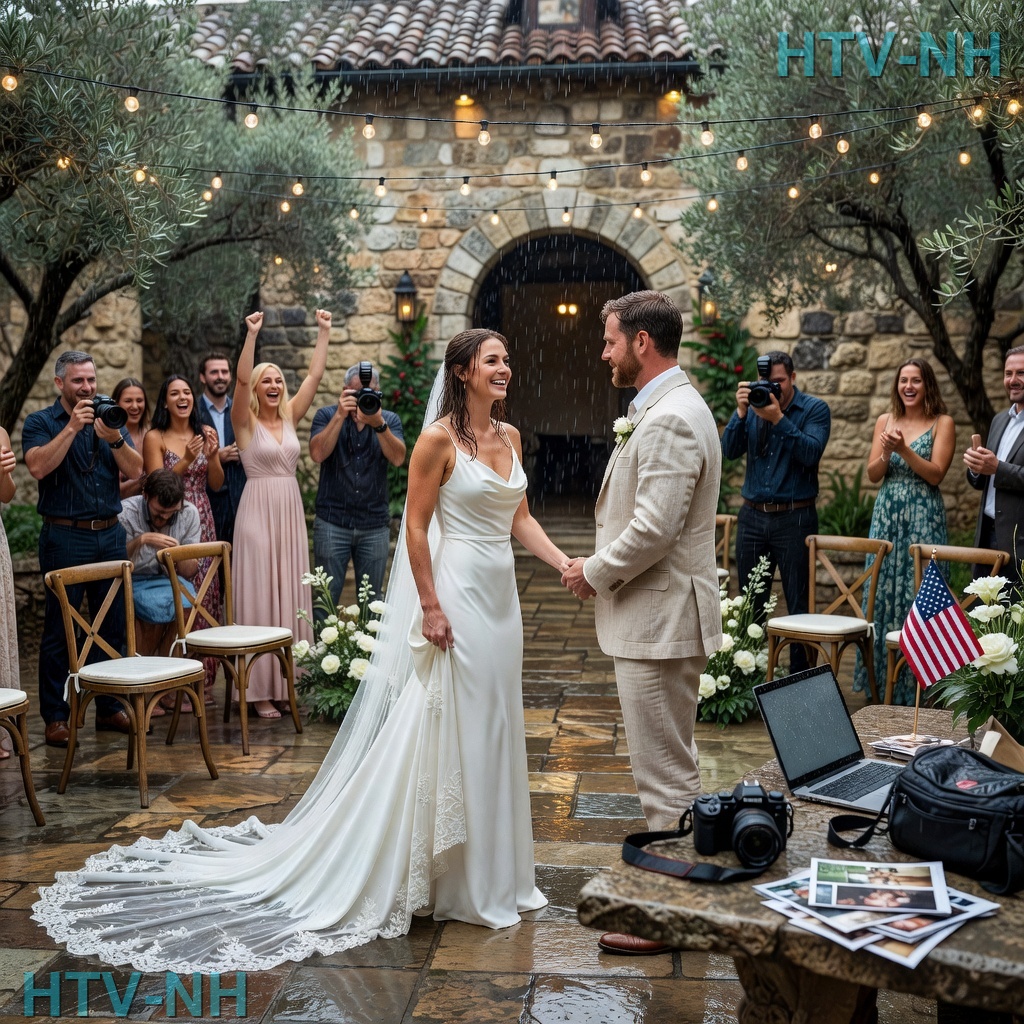
We exchanged vows in a rustic Italian courtyard under an unexpected, torrential downpour, completely soaked but genuinely happy. But our story didn’t end there. A candid, rain-streaked photo captured by a bystander accidentally caught a shocking detail in the background—a dark secret that exposed the twisted, real reason they never wanted me at that wedding in the first place.
————————————————————————————————————————
Banned to keep me invisible, I eloped in Italy for my own joy. I never expected one photo to expose their secret theft and ruin their fake wedding before…
My name is Harper. I was sitting cross-legged on the hardwood floor of my apartment in Denver, surrounded by the quiet hum of external hard drives and the sharp smell of stale iced coffee.
The glow of my dual monitors was the only light in the room, illuminating little dust motes that danced in the stagnant air. I was deep in the editing zone. I was tweaking the color grading on a wedding album for a client who had paid a premium for my signature style.
It was a style built on raw, unfiltered emotion. The kind of photography that captured the exact moment a tear slipped down a father’s cheek, or the nervous, fleeting twitch of a groom’s hand before he saw his bride.
I was good at seeing things other people missed. Honestly, looking back, perhaps that was the entire problem.
My phone vibrated violently against the floorboards, completely shattering the quiet of my studio. The screen lit up with a single name: Brenda.
My stomach did that familiar, sickening little flip it always did when my mother called. We did not have casual chats about the weather or try out new recipes together.
A call from Brenda meant instructions, critiques, or corrections. I took a deep breath, swiped the green icon, and put the phone to my ear.
“Hello, Mom,” I said, trying my absolute hardest to keep my voice neutral and light.
“Harper,” she said.
There was no greeting, no warmth. Her voice was crisp, like dry leaves stepping on pavement.
“We need to talk about next month, about the wedding.”
I leaned back against the edge of my sofa, rubbing my tired eyes.
“I already booked my flight, Mom. I sent you the confirmation last week. I land on the 14th at—”
“Don’t,” she interrupted.
The word was sharp. It was a command rather than a request.
“That is what I am calling about. You are not coming.”
I blinked, staring blankly at the frozen image of a smiling bride on my computer screen. The silence on the line stretched out, thick and suffocating.
“Excuse me?”
“You heard me,” Brenda continued, her tone shifting seamlessly into that maddeningly reasonable pitch she always used right when she was about to gaslight me into a different dimension.
“We have been discussing it, your father and I, and Clara, of course. We think it is best if you sit this one out.”
“Sit this one out?” I repeated, my voice involuntarily rising. “It is my sister’s wedding. I am her only sister. What are you talking about?”
“It is complicated, Harper. You know how it is,” she sighed.
It was a perfectly crafted sound of theatrical exhaustion.
“You have been doing so well lately with your little photography business. You have that look about you now, that polish.”
“You’re uninviting me because I look polished?”
“Stop being dramatic.”
“I snapped.”
“Listen to me,” she said, her voice turning icy. “If you come, people will look at you. They will ask about your work. They will talk about how successful you are in Denver. And for one day, just one single day, Clara deserves to be the only one people look at.”
“You appear, and suddenly the room shifts. You suck the air out of it, Harper. You always have. If you are there, Clara will be overshadowed at her own reception.”
The accusation hit me with the physical force of a blow to the chest. But it was not a new wound. It was a very old scar being violently ripped open.
I was suddenly seven years old again, holding a spelling bee trophy and being told to hide it in the very back of my closet so Clara would not feel bad about her failing grade in math.
I was sixteen, wearing a prom dress I bought with my own hard-earned money, being told I looked too aggressive and needed to tone down my makeup so I did not look prettier than my older sister.
“I would not do anything,” I whispered, my throat entirely tight. “I would just sit there. I would wear a burlap sack if you wanted.”
“It is not what you wear. It is who you are,” Brenda said.
The cruelty of that statement was so casual, so effortless, it quite literally took my breath away.
“We just want a peaceful day. If you love your sister, you will understand.”
The line went dead. She did not even say goodbye.
I sat there, the phone slipping from my sweaty palm. My heart was hammering against my ribs like a trapped bird.
Surely, this was a huge misunderstanding. Maybe Mom was just stressed about the catering. Maybe she was projecting her own anxieties. I needed a sanity check.
I felt a wave of dizziness wash over me. My hand, shaking uncontrollably, knocked right into the large glass of iced coffee sitting next to my keyboard.
It happened in agonizing slow motion.
The heavy glass tipped. The amber liquid surged out, splashing directly across the desk, soaking into my invoices, and pooling directly under my primary external hard drive.
The exact hard drive containing three solid months of client work.
“No,” I screamed, dropping the phone completely.
I scrambled forward on my knees, grabbing the metal drive, ripping the cord from the port. Sticky cold liquid dripped from the casing.
I frantically tried to dry it with the hem of my shirt, my breath coming in short, panicked gasps. I plugged it back in, praying to every single god I did not believe in.
The computer made a horrifying grinding noise. The screen flickered. The folder icon did not appear.
“No, no, no,” I sobbed, hitting the edge of the desk with my closed fist.
This was what they did. This was the true Martin family legacy.
They did not just hurt my feelings. They completely destabilized my reality. They made me shake until I broke the very things I had built with my own two hands.
They got inside my head until I destroyed my own work. I was sitting in a puddle of coffee and despair, holding a dead piece of metal that represented thousands of dollars and hundreds of hours of labor, all because they had convinced me I was unworthy of witnessing my own family’s joy.
The front door unlocked with a heavy click.
Julian walked in carrying two large brown paper bags of groceries. He stopped dead in the entryway.
Julian was a documentary filmmaker, a man who built narratives out of absolute chaos for a living. He took in the scene instantly.
He saw the spilled coffee dripping off the edge of the desk, the dead hard drive clutched in my hands, the hot tears streaming down my face, and my phone lying on the floor where I had abandoned it.
He dropped the grocery bags. They hit the floor with a heavy thud, apples rolling out across the wood.
He rushed over, completely ignoring the mess, and knelt beside me in the wet puddle.
“Harper, what happened? Are you hurt?”
He reached for my hands, gently pulling the dripping hard drive away before I could squeeze it to death.
I looked at him through my blurry vision. I saw the deep worry in his eyes, the genuine fear that I was physically injured.
He actually saw me. He did not look at me as a competition. He did not look at me as a threat. He did not view me as some annoying background character who needed to be dimmed down so someone else could shine.
I looked at the black screen of my computer. I looked at the coffee soaking deep into the expensive floorboards.
I thought about the non-refundable flight I would now have to cancel. I thought about the bridesmaid dress hanging in my closet, the boring, neutral-toned one I had bought specifically because it was modest and unassuming, chosen just to please my mother.
Something inside me snapped. But it was not a break. It was a complete realignment.
The frantic, suffocating heat in my chest rapidly cooled into something solid and incredibly hard, like steel tempering in freezing water.
I wiped my face with the back of my hand. The tears stopped immediately.
“Harper,” Julian asked gently, brushing a stray strand of hair from my damp forehead. “Talk to me.”
I took a deep breath, inhaling the sharp, bitter scent of the ruined coffee. It smelled like an ending.
“They uninvited me,” I said.
My voice was quiet, steady, and terrifyingly calm.
“Brenda. Mom. She told me not to come. She said my success takes away from Clara. She said I sucked the air out of the room.”
Julian’s jaw tightened instantly. The soft concern in his eyes shifted into a hard, protective anger.
“They did what?”
“I am done, Julian,” I said, looking him dead in the eye. “I am absolutely done editing myself out of the frame so they can feel bigger. I am done apologizing for the space I take up.”
I stood up. My legs were perfectly steady.
I looked down at the mess on the floor. It was the physical manifestation of the absolute chaos my family constantly brought into my life.
I would clean it up. I would pay the exorbitant data recovery fee. I would fix the work, but I would never, ever let them break me again.
Julian stood up to meet my gaze. He did not offer me empty platitudes. He did not tell me that family is family and they would eventually come around.
He just waited.
“I will not ask anyone for permission to exist anymore,” I said.
A plan formed in my mind instantly. It arrived complete and vivid, as if it had been waiting right there in the back of my brain for twenty-eight years, hidden just behind the heavy curtain of my lifelong obedience.
I turned to look at the blank calendar hanging on my wall.
“If they want me to disappear from my sister’s wedding,” I said, my voice barely above a whisper, “then I will show up brilliantly in the story of my own life.”
Sitting there in the aftermath of that phone call, I finally realized this was never just an isolated incident.
It was simply the grand finale of a miserable show that had been running for my entire life. The script had been written before I was even born, etched permanently into the foundation of our family dynamic.
Clara was the star. She was the fragile, expensive orchid that needed constant temperature control, specialized lighting, and round-the-clock admiration.
And I was the soil. I was the sturdy, dark thing that was entirely necessary for her growth, but was strictly expected to remain buried, dirty, and completely unseen.
I closed my eyes, and the memories washed over me again. Not as vague, blurry feelings, but as sharp, high-definition snapshots.
I remembered the state gold key I had won. I remembered handing the letter to my mother in the kitchen. I remembered her lips curving into a fake smile that did not quite reach her eyes.
“That is wonderful, Harper,” she had whispered, glancing nervously at the hallway. “But listen, Clara just failed her chemistry midterms yesterday. She is devastated. If we make a big fuss about this photography thing right now, it is just going to remind her that she is struggling. Let us keep this off the internet for a few days, okay? Just until she feels better.”
I had nodded. I had acted the part of the good, understanding sister.
I hid the certificate in my desk drawer. A few days turned into a week, then a month.
The post never went up. The celebration dinner never happened. My victory was suffocated quietly under the heavy pillow of Clara’s mediocrity just so she could sleep soundly.
Well, no more.
The soil was finally refusing to stay underground.
Despite the sudden surge of resolve, a tiny, pathetic part of me still needed to know if I was truly alone in this. I needed to know if my father was the architect of this banishment or just a passive bystander.
I picked up my phone, my fingers still slightly sticky with coffee, and dialed Richard’s number.
“Hey, Dad,” I said the exact moment he picked up.
I was practically begging for him to laugh it off, to tell me my mother had lost her mind over catering budgets.
“Mom just called me and said the craziest thing. She said I am uninvited. Please tell me she is just having a pre-wedding meltdown.”
Richard cleared his throat. The sound was dry, scratchy, and incredibly uncomfortable.
“Harper,” he said.
And the complete lack of surprise in his voice shattered the very last tiny sliver of hope I had left.
“Your mother and I, we talked about this at length.”
“So you agree?” I asked, my voice cracking despite my best efforts to keep it firm. “You actually agree that I should not be there?”
“Look, honey,” he said, his voice dropping into that conspiratorial hush-hush whisper that always made me feel physically sick.
It was the voice he used when he wanted me to hide my accomplishments.
“Clara is very fragile right now. She is under a lot of pressure with the planning. Derek has very high standards. Having you there, it introduces an element of competition she simply cannot handle right now.”
“Think of it this way, kiddo. Your absence is a gift. It is a gift you are giving your sister.”
A gift? My complete erasure was the only present they actually wanted from me.
“Dad,” I said, my voice hardening. “You are asking me to miss the biggest day of her life because you are too afraid to tell Mom she is being insane.”
“Do not speak about your mother that way,” he snapped, his defensive cowardice flaring up. “We are trying to protect the peace. You have always been the strong one, Harper. You can handle this. Clara needs this day to be perfect.”
“Right. Protect the peace,” I muttered. “You mean protect your peace so Mom doesn’t yell at you.”
“Harper, please be reasonable.”
I hung up. I didn’t slam the phone down. I just gently pressed the red button, cutting off his pathetic excuses.
The realization was absolute. My father knew this was wrong. He knew it was deeply unfair. But he willingly chose to sacrifice his youngest daughter to the wolves just to keep his living room quiet.
That was the cowardice of complicity. It was almost worse than Brenda’s direct cruelty.
I looked up at Julian. He was leaning against the door frame, arms crossed, watching me with a quiet, fierce intensity.
“He knew,” I said simply. “He told me my absence is a gift.”
Julian shook his head, a look of pure disgust crossing his features.
“They’re casting a production. Harper, this isn’t a family. It’s a stage play. But your life is not a supporting role.”
“I know,” I said. “I am not fighting for a seat at a table where they don’t even want me to eat.”
Julian walked over, took my hands, and pulled me to my feet.
“Then what are we doing?”
“We are getting out of Denver,” I said.
The air in this apartment feels too thick right now. It is recycled with the oxygen of a thousand apologies I have never received. We need to clear our heads.
We packed an overnight bag and drove south, watching the Rocky Mountains fade into the rearview mirror until the landscape flattened out.
We rented a small adobe casita in Santa Fe for two days. The goal was not to sightsee. The goal was to completely cut the signal.
I needed to turn off the constant buzzing noise of my mother’s voice living rent-free in my head and hear what my own thoughts actually sounded like for the first time in twenty-eight years.
We sat on the patio of the casita drinking cheap wine and watching the high desert light shift from harsh white to a bruised, beautiful purple.
We barely spoke about the wedding in Charleston. It was in that quiet space that Julian brought up Matteo.
“You remember the guy I shot that olive oil documentary for a few years ago?” Julian asked, swirling the dark wine in his glass.
“Matteo in Puglia?” I asked.
I remembered seeing the raw footage. It was not the polished, highly commercialized Italy of expensive travel brochures. It was raw stone, ancient olive trees, and natural light that looked like it had been painted by a Renaissance master.
“Yeah, he texted me last month,” Julian said. “He converted the old stables of his Masseria into a small event space. He said he is so tired of big fake American weddings where the bride cries because the napkins are the wrong shade of white. He wants to host real things, small things, honest things.”
I looked out at the desert horizon. I closed my eyes and imagined it.
Not a performance, not a massive production with five hundred guests and a floral budget that could literally feed a small country.
Just stone, wind, and absolute truth.
“Let’s go,” I said.
Julian stopped swirling his wine.
“To Italy? For a vacation?”
“No,” I said, turning to look at him.
My heart was beating fast, but it wasn’t panic. It was thrill.
“To get married. Let’s elope. We wanted a small wedding anyway. Let’s do it there. Just us and the twenty people who actually give a damn about us.”
Julian’s face broke into a slow, brilliant smile.
“You mean it.”
“I have never meant anything more in my life.”
It was not a decision born of malice. I need to be completely clear about that.
In that specific moment on the patio, I was not thinking about how to hurt Clara or how to one-up Brenda. I was thinking purely about survival.
I knew that if I stayed home in Denver on the day of her wedding, crying on my couch, I would dissolve. I was choosing to live. I was choosing joy.
We pulled out our laptops right there on the patio and started planning.
It was not a nervous bride’s checklist. It was a professional producer’s run sheet. I approached it exactly the way I approached my best photography work.
I did not want perfect poses. I wanted documentary reality.
We kept the guest list at exactly twenty people. It was a list of names that instantly made my chest feel light.
No heavy obligations. No distant, judgmental cousins who would whisper about the centerpieces.
Just the people who had held me up when my own blood was busy pushing me down. Morgan, my mentor from the studio, a few close college friends, and Julian’s small crew.
I opened a spreadsheet and typed furiously.
Lighting: natural only.
Ceremony: golden hour.
Dinner: candlelight.
No fake atmosphere.
Weather: late spring in Puglia means a high chance of sun, but if it rains, we let it rain. We do not hide from the elements.
Then came the dress. I found a designer online who worked exclusively with deadstock vintage silk.
I did not want a massive train that required three exhausted bridesmaids to carry. I did not want stiff corsetry that made it hard to breathe.
I chose a simple slip dress, silk bias-cut, something that moved with me like a second skin.
By the time we drove back to Denver the next afternoon, the plan was entirely locked. Flights were booked. The deposit was sent to Matteo.
We were doing this, which meant I had to make the call.
I waited until I was back in my own apartment, surrounded by my own things. I needed to do this standing squarely on my own two feet.
I picked up the phone and dialed Brenda.
“Hello,” she answered on the second ring.
Her voice was highly distracted. I could clearly hear the obnoxious rustle of tissue paper in the background.
“Harper, make it quick. We are doing the final fitting for the bridesmaids’ sashes, and the shade of blush is completely wrong. It washes Clara out.”
“I am not coming to the wedding, Mom,” I said. “I know you uninvited me, but I am making it official. I will not be in Charleston.”
“Good,” she said dismissively, not missing a beat. “It is for the best. I am glad you are finally being mature and reasonable about this.”
“I am going to Italy,” I continued, my voice steady, refusing to let her steamroll me. “Julian and I are getting married in Puglia, three days before Clara’s ceremony.”
The rustling of tissue paper stopped dead. The silence on the other end of the line was absolute, heavy, and extremely dangerous.
“Excuse me?” Her voice dropped a full octave.
It was the exact tone she used right before a major explosion.
“We are getting married,” I repeated clearly. “Small, private, just friends.”
“You are joking,” she whispered, the venom leaking through.
And then the volume spiked so hard I had to pull the phone away from my ear.
“You are absolutely joking. You cannot be serious. You’re going to get married now, right before your sister’s big day.”
“It does not affect her day. Mom, I am not inviting any family. It is thousands of miles away.”
“It is sabotage,” she screamed. “That is what this is. You are so terribly jealous. You are trying to steal her thunder. You just want people to be talking about you instead of her. How dare you, Harper? How dare you be so unbelievably selfish.”
I held the phone a few inches away. The words were painfully familiar, but strangely, they did not sting the way they used to.
They felt distant, like a loud radio playing in another room.
“I am not stealing anything,” I said, genuinely surprised by how incredibly calm my own heartbeat felt. “Clara can have her day. She can have the five hundred guests and the imported Paris flowers. I am just having a life.”
“You are doing this strictly despite us,” she accused, breathing heavily. “You are trying to make us look bad. What will people say when they find out the sister ran off to elope right before the wedding of the century?”
“They will say nothing,” I replied smoothly. “Because you told them I was not welcome anyway, right? Remember your exact words. My absence is a gift. Consider this me wrapping it up with a bow.”
“I forbid it,” she snapped, her control completely unraveling. “You will wait. You will wait until next year, or you will not do it at all.”
I looked down at my left hand. I was not wearing a ring yet, but I could already feel the weight of the promise I had made to myself in the desert.
“I am not asking for permission, Mom,” I said softly. “I am informing you. I am completely done asking for permission.”
“If you do this,” she hissed, her voice dripping with pure malice, “do not expect a single person from this family to ever support you again.”
“I never did,” I said.
And I hung up.
My hands were shaking, but it was not from fear. It was the pure electric adrenaline of a prisoner who had just casually walked out of an open gate.
I took a deep breath, fully expecting the crushing, familiar guilt that usually followed setting boundaries with my mother.
But it did not come. The air in my apartment tasted surprisingly sweet.
The assault began at exactly seven in the morning, precisely three hours after I had officially confirmed the flight tickets to Bari.
My phone, usually a peaceful tool for client communications and quiet, mindless scrolling, transformed overnight into a vibrating weapon of mass guilt.
It was not just Brenda anymore. She had activated the network.
The extended family, the classic flying monkeys of the Martin dynasty, had been successfully deployed to bring the rogue sheep back to the slaughterhouse.
The very first text came from Aunt Sarah, a woman who had literally not spoken a word to me since Christmas two years ago.
“I just heard the news,” she wrote. “I cannot believe you would do something so incredibly toxic to your sister. Clara is hyperventilating. She might have to go to the emergency room because of the stress you are causing. Please, Harper, for once in your miserable life, think about someone else.”
Then came cousin Mark.
“Not cool, Harp, making this all about you. Classic middle child syndrome.”
Then came a relentless barrage from numbers I had either never saved or had happily deleted years ago.
Messages flooded my screen filled with aggressive words like selfish, cruel, attention-seeking, spiteful, and jealous.
They collectively painted a terrifying picture of a scene down in Charleston that was nothing short of a Greek tragedy.
According to them, Clara was collapsing in a heap of expensive tulle and hot tears, gasping for air, her fragile heart completely breaking because her wicked, jealous sister had maliciously decided to get married in Italy just to ruin her vibe.
I felt that old familiar squeeze in my chest. That deep childhood conditioning kicking in automatically.
Am I hurting her? Is she really sick? Did I push too hard?
“Check the feed,” Julian said.
He was standing right over my shoulder holding two mugs of coffee, watching the notifications stack up on my lock screen like aggressive Tetris blocks.
“Do not reply to a single one of them. Just check the feed.”
I opened Instagram. I went straight to Clara’s public profile.
Given the messages I was receiving, I fully expected radio silence or maybe a vague sad quote about family betrayal set against a black background.
Instead, I saw a series of high-definition stories posted exactly fifteen minutes ago.
Clara was not in a hospital. She was not hyperventilating into a paper bag.
She was at an exclusive bridal brunch in a sun-drenched, beautifully manicured garden, holding a crystal glass of expensive pink champagne.
In the next slide, she was throwing her head back and laughing uproariously with her six perfectly styled bridesmaids, a piece of red velvet cake elegantly poised on a silver fork.
“Taste testing,” the caption read, followed by a diamond ring emoji and a sparkling heart.
She looked radiant. She looked completely unbothered. She looked perfectly, one hundred percent fine.
The cognitive dissonance made my head spin. The text messages screaming that I had put her on life support were arriving at the exact same millisecond as 4K videos of her doing a cute little shimmy for the camera.
“They are lying,” I whispered, staring at the screen in disbelief. “They are literally inventing an alternate reality where I am the villain, even when the visual evidence that she is totally fine is right there in public.”
“It is a coordinated psychological attack,” Julian said.
His voice dropped into that professional, highly detached tone he used when a film shoot was going sideways and he needed to manage the crisis.
“They want you to crack. They want you to panic, call them crying, and apologize for existing. Do not give them the fuel.”
He gently took the phone from my hand.
“New rule,” he announced. “We do not engage. We do not defend ourselves. We screenshot everything.”
“Screenshot everything?” I asked.
“Everything,” Julian affirmed. “Every text, every voicemail, every DM. We build a digital folder. If they escalate this, we have timestamped receipts, but we do not reply. Silence is the one thing narcissists absolutely cannot manipulate.”
I nodded, feeling a strange, powerful sense of calm wash over the initial panic.
Documentation. I was a photographer. I could definitely handle documentation.
I picked up my laptop and drafted a quick BCC message to our small, curated group of guests, the twenty people who were actually flying to Italy.
I kept it brief and professional.
“Heads up, everyone. My family is not very happy about this trip. They might try to reach out to you to verify details or tell you some crazy stories to get you to cancel. Please just ignore them. If you get a weird message, let me know. Love, Harper.”
I thought that would be enough. I thought the boundary was firmly set and the storm would pass.
I was incredibly naive, because two hours later, I realized my mother wasn’t just trying to make me feel bad.
She was trying to completely sabotage the event.
I had to go into my phone settings and block my family. I went into the group chat, Martin Family Updates, just to see if Richard had chimed in.
I scrolled to the bottom. I couldn’t type.
At the bottom, in small gray text, it read, “You were removed from this group.”
I stared at the date stamp next to the notification. It was not from today. It was not from last week when they supposedly made the tough decision to uninvite me.
It was from exactly six months ago.
I sat there frozen. Six months ago. That was exactly when Clara got engaged.
They hadn’t just kicked me out of the wedding. They had surgically erased me from the conversation half a year ago.
They had curated a separate, completely isolated reality where I did not exist. Long before they had the courage to tell me to my face, I was already gone.
A strange cold smile touched my lips. They handed me the scissors to cut the cord.
Later that afternoon, the real reason for my exile finally surfaced, and it had absolutely nothing to do with my mother’s obsession with Clara being the center of attention.
My phone buzzed with a message from Morgan.
Morgan was an event planner based in South Carolina. Nothing happened in the Charleston wedding scene without her knowing the venue, the vendor list, and the hidden drama.
Unlike the barrage of family guilt trips, Morgan’s messages were always highly tactical.
This text contained a single hyperlink and a very short sentence.
“Do not scream.”
I clicked the link. It opened a browser window to a sleek, insanely high-end custom wedding website.
The header drifted in with elegant, expensive fade effects.
The Union of Clara and Derek. A Charleston Love Story.
It was beautiful. It was polished. It looked like a million bucks.
And it was a complete, massive lie.
The hero image, the massive high-resolution background photo that took up the entire screen when you loaded the page, was a breathtaking shot of a couple kissing under a romantic veil of Spanish moss, caught in a perfect sunflare that turned the whole world a deep liquid gold.
It was a breathless, stunningly romantic image.
It was also completely mine.
I froze, my hand hovering stiffly over my laptop trackpad. I knew every single pixel of that image.
I had taken it exactly three years ago at an ultra-luxury destination wedding in Savannah for a semi-famous lifestyle blogger.
It was the exact shot that had launched my solo career. It was the image that had gotten me a four-page feature in major industry magazines.
I scrolled down, my heart thumping a slow, dangerously heavy rhythm against my ribs.
The website was absolutely riddled with my professional work. The section about their vision used my portfolio shot of an extravagant table setting from a vineyard in Napa Valley.
The registry page used a macro detailed shot of diamond rings I had taken during a blizzard in Aspen.
They had aggressively built their entire digital aesthetic, the visual promise of their luxury wedding, on the foundation of my unpaid labor.
I zoomed in on the bottom right corner of the hero image. My watermark, the subtle, elegant little logo I meticulously placed on all web files to protect my copyright, was entirely gone.
It had been clumsily, horribly cloned out using Photoshop, replaced by a blurry, pixelated patch of green leaves.
I scrolled to the very bottom of the page, my blood running ice cold.
There, in a small modern sans-serif font, was the final insult.
Photography and visual direction by Derek.
I sat back hard against my chair. All the air rushed out of my lungs at once.
It was not a misunderstanding. It was not a family quirk. It was blatant illegal theft.
And suddenly, every single puzzle piece of Derek’s intense animosity toward me clicked together with a terrifying, crystal-clear precision.
My family had always told me Derek hated me because I was an artsy snob or too critical.
That was a total smokescreen.
Derek did not hate me because I was judgmental. He hated me because I was the living, breathing evidence of his fraud.
Morgan had told me Derek was trying to pivot his career. He was desperately trying to build a personal brand as a high-end tastemaker and a lifestyle entrepreneur.
He was using my highly professional copyrighted intellectual property to aggressively sell himself to high-ticket corporate sponsors and luxury vendors.
He was presenting my years of artistic output as his own brilliant vision.
If I showed up at that wedding in Charleston, if I walked around the reception shaking hands and people asked, “Oh, you’re Harper the photographer. Did you take these amazing photos on the website?” the entire house of cards would violently collapse.
My mere physical presence in South Carolina was a massive, unmanageable liability, not to Clara’s delicate feelings, but to Derek’s fraudulent business scam.
I was not uninvited to protect my sister’s mental health. I was banned to protect a business transaction.
They did not need a sister at that wedding. They needed a disposable prop. And when the prop started having its own opinions, and more importantly, owning its own copyrights, they cut it out of the picture.
I stood up and walked over to the window, looking out over the Denver street.
The heavy, suffocating guilt that had been quietly gnawing at my stomach for days finally evaporated completely. It burned away, replaced by a profound, icy resolve.
I picked up my phone.
I didn’t call Brenda. I didn’t call Clara to scream.
I dialed Diana.
Diana was a ruthless, brilliant copyright attorney I had met at a creatives conference two years ago. She had zero patience for art theft and a very deep love for legal warfare.
“Diana,” I said when she answered. “It’s Harper. I need you to look at a URL right now.”
I hit send on the link, feeling a cold smile touch my face.
The smoke and mirrors were about to be shattered.
I did not feel the fiery, chaotic rush of revenge. I felt the absolute cold clarity of a business transaction.
This was the core difference between me and my family.
They operated on wild emotion, on psychological manipulation, and on the incredibly messy currency of familial guilt.
I operated on signed contracts, legal lighting ratios, and federal copyright law.
I sat on my sofa and listened to Diana typing furiously on her end of the phone line. She had the website pulled up in seconds.
“Okay, I am looking at it,” Diana said, her voice clipped and entirely professional. “Nice site, very high production value. Who is this guy again?”
“My future brother-in-law,” I said, watching my cursor blink over my stolen photograph. “The hero image and the three images in the gallery section, they are mine. I have the raw files. They are fully copyright registered. The watermarks have been intentionally edited out, and the footer credits him as the visual director.”
“Edited out?” Diana asked, her tone sharpening instantly.
She lived for this exact kind of blatant violation.
“As in completely removed, cloned out with a fake leaf texture,” I confirmed.
“That is a direct violation of the Digital Millennium Copyright Act,” Diana said without a moment of hesitation. “And since they actively removed the copyright management information, the watermark, that is a separate violation of federal law. This is not just rude family drama, Harper. This is highly actionable. We can sue for damages.”
“I do not want money,” I said, my voice completely flat. “I just want it down.”
“Today, we can file a takedown notice directly with the hosting provider,” Diana explained, her keyboard clacking aggressively in the background. “It is a standard, highly effective procedure. We send the raw file proof of ownership, alert the web host that the material is legally infringing, and they are required by federal law to remove it immediately to avoid their own liability. No lawsuit, no messy court appearance, just a digital eviction.”
“Do it,” I said.
“Are you absolutely sure?” Diana paused, her lawyer instinct kicking in. “This is your family, Harper. A takedown notice shuts off the images, but it usually takes down the entire site depending on the host’s strict policy. It is going to leave a massive, glaring black hole in their marketing right before their big day.”
“It is not marketing,” I said, staring at the screen. “It is my life’s work. Send it.”
I hung up the phone. I did not text Brenda. I did not confront Clara.
I went into my bedroom, pulled out my suitcase, and started packing for Italy.
Thirty minutes later, my phone pinged. It was a quick email from Diana.
The notice was submitted. The web host usually processed these within twenty-four hours, but given the undeniable proof of the raw files, she expected it to be much faster.
I waited. The sun slowly moved across the hardwood floor of my apartment.
Julian was packing his camera gear in the living room, sensing the heavy shift in my energy, but giving me the quiet space I needed.
Then my phone lit up.
It was not a phone call. It was a text message from a strange number I did not recognize.
No area code. It looked exactly like a cheap burner number or a web-generated text.
“If you keep destroying this, you will have absolutely no family left to come back to. Stop now.”
I stared at the glowing screen. The voice was intentionally ambiguous. It sounded slightly like my mother’s typical hysteria, but the specific phrasing, destroying this, felt exactly like Derek.
It felt exactly like a desperately ambitious man watching his lucrative stolen investment crumble into dust.
For years, I had completely believed the narrative that I was the black sheep because I was inherently difficult.
Because I was too loud, too ambitious, too much for my delicate sister to handle.
I had spent thousands of dollars on therapy trying to figure out how to be softer, how to be the perfect, quiet background sister.
But looking at that threatening, anonymous text, I realized the truth was much simpler and infinitely uglier.
They did not need a sister at that wedding. They needed a silent prop to make their fake aesthetic look believable.
And when the prop started enforcing legal boundaries, they tried to terrify it back into submission.
I deleted the text. I did not reply.
I grabbed my passport and walked out the door.
The transatlantic flight to Bari was a long, exhausting blur of recycled air and fitful sleep.
But the exact moment Julian and I stepped out of the small regional airport, the entire world fundamentally changed.
The air here was entirely different. It did not smell like exhaust fumes and deep-seated anxiety. It smelled intensely of dried earth, salty Mediterranean wind, and something incredibly ancient, like sunbaked stone.
We picked up our rental car, a dusty little vintage hatchback that rattled charmingly when it idled, and drove deep into the south.
The landscape of Puglia unfolded around us like a masterful oil painting that had been left out in the bright sun for centuries.
The soil was a rich rusty red, contrasting violently with the muted silver-green leaves of the endless olive trees.
These were not the polite, heavily manicured trees of a luxury landscaping brochure in Charleston.
They were gnarled, twisted giants. Their trunks were split and knotted, holding their ground with a stubborn, quiet resilience that I instantly and deeply respected.
We arrived at Matteo’s Masseria in the late afternoon.
It was a heavily fortified farmhouse dating back to the sixteenth century, built entirely from massive blocks of pale golden limestone that seemed to literally glow from within.
There was no grand, ostentatious ballroom. There were no crystal chandeliers, and there were absolutely no white satin chair covers.
Instead, there was a vast central courtyard paved with uneven historical flagstones, bordered by high walls covered in fragrant climbing jasmine.
A simple canopy of warm string lights crisscrossed overhead, patiently waiting for the dark.
Long, heavy wooden tables, scarred and deeply stained from decades of loud communal meals, sat ready for our small reception.
It was not pristine. There were little green weeds growing stubbornly between the stones.
The plaster was peeling in certain places to reveal the raw rock beneath, but it felt incredibly warm.
It felt like a real place where actual messy life happened, not an expensive movie set built strictly for a shallow photo opportunity.
Matteo met us at the heavy iron gate, enveloping Julian in a massive hug that looked like it could crack a rib.
He turned to me, his dark eyes crinkling warmly at the corners.
“Welcome home, Harper,” he said simply.
He did not treat me like a fragile, stressed-out bride who needed to be carefully handled. He treated me like a weary traveler who desperately needed a glass of wine and some fresh bread.
We spent the evening settling in, but the reach of the Martin dynasty was apparently global.
Later that night, as we were tasting the local wine in the kitchen, Matteo pulled me aside. His usually jovial face was dead serious.
“Harper, I had a very strange phone call this afternoon before you arrived,” he said quietly, wiping his large hands on a kitchen towel. “A woman? She spoke very loud, very demanding English. She said she was the mother of the bride.”
My stomach instantly tightened into a hard knot.
“Brenda. What did she say?”
“She demanded to know the exact time the ceremony begins tomorrow,” Matteo said, a deep frown settling on his face. “She said she needed to coordinate a very large surprise delivery of flowers. She aggressively asked me for the full guest list, and then she demanded the digital security code to the main iron gate.”
I felt the blood completely drain from my face.
Brenda was not just yelling into the void anymore. She was actively hunting me.
She was trying to get the guest list to harass my friends. She was trying to get the gate code to send someone to ruin the venue or cancel the catering.
The invasion felt shockingly physical, like someone was trying to pick the lock on my front door while I was sleeping.
“Matteo,” I said, my voice trembling slightly despite my best efforts. “That was my mother. She is strictly not invited. She is not sending flowers. Under no circumstances do you give her any information. Not even the time of day.”
“I thought as much,” Matteo said, his tone instantly shifting from confused host to fiercely protective friend. “She sounded incredibly aggressive. Do not worry, Harper. This is Puglia. We know exactly how to handle aggressive people, but we need a strict system. A password.”
“A password?” I asked.
“Yes,” he said firmly. “From now on, absolutely no changes are made to the menu, the timeline, or the gate access list unless you say the specific word to me. If the Pope himself calls the Masseria, if he does not have the word, he does not get inside.”
“Cinnamon,” I said.
It was the very first random word that popped into my panicked brain.
“Cinnamon,” Matteo repeated, nodding once. “Done. Rest easy, Harper. The Masseria is a fortress now. The gates are locked.”
The night before the wedding, Julian came into our small stone bedroom with his tablet glowing in his hand.
He looked incredibly hesitant, running a hand nervously through his hair.
“So,” he said, sitting heavily on the edge of the antique bed. “I just checked the local meteorological forecast for tomorrow afternoon.”
“And?” I asked, looking up from the book I was trying to read.
“It has shifted drastically,” he said, turning the screen toward me. “There is a massive weather front moving in straight from the coast. There is an eighty percent chance of heavy rain right at five. Exactly during our vows in the courtyard.”
I stared at the digital radar map on the screen. The bright green and yellow blobs were heading straight for our little town.
Rain, of course.
In my mother’s meticulously curated narrative, this would be the ultimate divine punishment.
See, she would tell all her friends at the country club, “Even God thinks Harper is making a terrible, selfish mistake.”
A rainy wedding was considered an absolute, unmitigated disaster in the bridal magazines I used to shoot for.
It ruined the expensive hair blowouts. It completely muddied the hems of the designer gowns. It made the wealthy guests grumpy and miserable.
For ten long seconds, I felt that old, familiar panic rising in my throat.
I vividly pictured the open, completely exposed stone courtyard. I pictured the romantic candles sputtering out in the downpour.
I pictured Brenda sitting in her luxury suite in Charleston, somehow sensing the storm and laughing at my ruined day.
But then I stood up and looked out the small wooden window at the dark, silent outline of the ancient olive trees swaying in the rising wind.
This was not a performance. This was not about getting the perfect sun-drenched shot for a lifestyle blog so we could get free hotel stays.
This was about standing next to Julian, the man who actually saw me, and making a promise to build a real life together.
“Okay,” I said, turning back to him.
“Okay?” Julian asked, raising one skeptical eyebrow. “Do you want to ask Matteo to move the ceremony into the old barn? It will be tight with twenty people and the camera gear, but we can make it work.”
“No,” I said, entirely surprised by my own fierce certainty. “Let it rain.”
Julian blinked.
“You are sure?”
“The limestone looks incredibly beautiful when it is wet,” I said, a genuine, bubbling laugh escaping my throat.
It felt strange and wonderful after weeks of pure tension.
“The greens of the trees get so much deeper. Rain is just different lighting, Julian. It is just texture. We are not made of sugar. We will not melt.”
He smiled, a wide, breathtaking smile, and leaned in to kiss my forehead.
“That is the hardcore producer in you talking.”
“No,” I whispered against his shoulder. “That is the woman who is completely done being afraid of a little water.”
I lay back on the pillows that night, listening to the wind actively pick up outside the thick walls.
I realized right then that for twenty-eight years, I had completely believed my family was all-powerful.
I believed their disapproval could literally stop the sun from rising. I believed their anger could shape physical reality.
But here, halfway across the world, among the olive trees and the solid limestone, their immense power was nothing but a tiny, annoying voice on a phone line that I could simply choose not to answer.
Their iron grip only existed if I willingly stayed within their radius.
I was officially out of range.
And for the first time in my entire life, as the first drops of rain hit the roof, I could truly breathe.
The light that afternoon did not behave the way any of the expensive weather apps predicted.
Around four, the harsh Italian sun softened beautifully, filtering through a sudden, heavy accumulation of dark clouds rolling in from the Adriatic Sea.
It turned the entire stone courtyard into a massive natural light box.
It was exactly the kind of diffused, cinematic lighting that professional photographers spend thousands of dollars trying to replicate in a commercial studio.
Everything looked completely magical.
The stone walls glowed with a warm honeyed hue, and the skin of everyone present seemed to be smoothed by an invisible perfect filter.
I stood in the heavy wooden doorway of the Masseria, checking my reflection one last time in the glass pane.
I was not wearing the massive, restrictive princess gown Brenda had always aggressively envisioned for me.
I wore a simple bias-cut silk slip dress that skimmed my body naturally without constricting my lungs.
My hair was pulled back into a low, slightly messy bun, secured with a single antique silver pin I had found in a chaotic flea market in Bari.
I did not look like a posed model in a glossy bridal magazine. I looked like a real woman who had dressed up for a very important dinner date with the love of her life.
As I stepped out onto the wet flagstones, a heavy wooden door to the neighboring property creaked open.
An elderly Italian woman, no taller than five feet, shuffled out slowly. She was wearing a faded house dress and an apron heavily stained with white baking flour.
She was a lifelong friend of Matteo’s, a fixture of the small village who had been watching our frantic preparations with mild, silent curiosity all day.
She walked right up to me, completely ignoring Julian’s documentary camera crew, and gently pressed a small, fragrant bundle of wild greenery directly into my hands.
It was not a thousand-dollar florist’s bouquet. It was wild fennel, fresh rosemary, and tiny purple field flowers tied together with a rough piece of brown twine.
“Congratulations, beautiful,” she said, her voice sounding like cracking parchment. “Life is yours.”
I did not speak fluent Italian, but I understood the immense weight of the gesture.
She patted my cheek with a warm, calloused hand and shuffled right back inside to her kitchen.
I held the rough herbs tightly against my silk dress. They smelled incredibly sharp and green, scenting the damp air with something that felt deeply grounding and real.
I walked the rest of the way down the courtyard to Julian.
There was no string quartet playing traditional music. There was just the distinct sound of the wind moving heavily through the olive branches.
I did not have a father to walk me down the aisle and hand me off like a piece of property.
I walked myself. I belonged entirely to myself.
We stood under the gnarled, twisting branches of the oldest tree in the grove, tightly holding hands.
As I began to speak my handwritten vows, the air pressure suddenly dropped. The eighty percent chance of rain finally arrived.
But it did not come as a violent, destructive storm.
It started as a fine, beautiful mist, a glittering dust that caught the late afternoon light and made the air sparkle.
But then the wind kicked up.
A sudden sharp gust swept right through the stone courtyard, swirling the fallen olive leaves and catching the lightweight hem of my silk dress.
The fabric whipped fiercely around my legs, lifting high enough in the wind to reveal the inner silk lining.
For a split second, the custom embroidery was fully visible to the crowd.
No permission needed.
The dark, heavy thread stood out starkly against the cream-colored silk.
Julian saw it and let out a bright, loud laugh. Morgan, sitting in the front row with her smartphone out, tapped her screen.
Somewhere in that small crowd of twenty guests, a camera shutter clicked loudly.
It was not a staged, perfectly posed photograph. It was a rapid capture of raw, unscripted reality.
We completely finished our vows in the pouring rain. Our hair was completely damp. The water was running down our faces, and we were laughing uncontrollably as we kissed.
It was deeply imperfect. It was messy. It was undeniably the absolute best moment of my entire life.
We moved the dinner reception under the massive stone archways of the old stables to escape the steady drizzle.
The mood in the room was purely electric.
We drank rich Primitivo wine out of simple glass tumblers and ate massive bowls of orecchiette pasta, happily passing the heavy ceramic plates family-style for two straight hours.
Sitting there surrounded by loud laughter and the smell of garlic, I completely forgot about Charleston.
I forgot about the aggressive text messages. I forgot about the banishment.
Then Morgan cleared her throat.
“Harper,” she said, her voice sounding strangely tight in the acoustic echo of the stone archway. “You really need to look at this.”
She slid her phone across the scarred wooden table.
One of my good friends from college, a girl named Chloe, who happened to have a fairly modest but highly engaged following on Instagram, had posted the photograph she took during the ceremony.
It was the exact shot of the sudden wind lifting my dress.
The composition was accidentally breathtaking.
Julian and I were throwing our heads back, laughing in the diamond-dust rain. The ancient twisted olive tree perfectly framed us in the background.
And that secret, defiant message embroidered on the silk lining was perfectly, sharply legible right in the dead center of the frame.
No permission needed.
Chloe’s caption was very short but lethal.
“She was uninvited from her sister’s luxury wedding because she took up too much space. So, she invited herself back into her own beautiful life. No permission required.”
I looked at the small timestamp at the top of the post. It had been published exactly three hours ago.
“Look at the numbers,” Morgan whispered, her eyes wide.
I scrolled down past the image.
The post had exactly forty thousand likes.
“Is that a glitch?” I asked, blinking rapidly. “Did she buy bots?”
“No,” Morgan said, shaking her head. “It is a movement.”
I tapped on the comment section. It was scrolling upward so fast my eyes could barely track the text.
“This is the exact main character energy I desperately need right now.”
“Wait, she was uninvited? Who uninvites their own sister?”
“The embroidery. I am screaming.”
“That is completely iconic.”
“I absolutely need to know the entire backstory. Who is the awful sister? Tell us everything.”
The photo had entirely escaped the safe containment field of our small private friend group.
It had hit the global explore page algorithm. It was actively being shared across Twitter and TikTok.
Thousands of strangers were using a trending soundbite about independence to narrate over my wedding image.
The simple raw narrative of the uninvited sister had struck a massive collective nerve with everyone on the internet who had ever felt marginalized, silenced, or bullied by their own toxic family members.
“It is going viral,” Julian said, leaning heavily over my shoulder to read the screen. “Like actually, undeniably viral. But the internet is a massive, relentless detective agency that absolutely never sleeps.”
Around midnight, just as we were cutting the traditional Italian millefoglie cake, the entire tone of my phone notifications fundamentally changed.
A highly popular wedding commentary account on TikTok, one with over two million followers, known entirely for ruthlessly dissecting bridal drama, had officially picked up the story.
The creator had done a reverse image search on my specific face. They easily found my professional photography portfolio.
And then, because the internet truly never forgets anything, they found the legally cached version of Clara and Derek’s wedding website.
The exact website we had legally taken down with the copyright notice just days before.
The account posted a rapid-fire video breakdown.
“Okay, guys, grab your tea. The viral uninvited bride from Italy is Harper, an incredibly talented professional photographer. I did some deep digging. Her sister, the one who viciously uninvited her, had a luxury wedding website up until exactly two days ago. Guess whose professional photos were plastered all over that luxury site? Harper’s. Guess who was fully credited as the creative director? The groom.”
“They didn’t just uninvite her for being too pretty. They blatantly stole her intellectual property to get sponsors and then kicked her out so she wouldn’t blow their cover. This isn’t just petty family drama. This is massive corporate theft.”
The comment section beneath that video completely exploded.
The public sentiment instantly shifted from sweet admiration for my romantic rebellion to absolute righteous anger on my behalf.
People were aggressively tagging Derek’s public business Instagram account.
They were hunting down the luxury vendors in Charleston and flooding their comments, asking if they knew they were actively working for a fraud and an art thief.
The perfect, pristine family narrative my mother had spent decades carefully curating was being violently dismantled in real time by millions of strangers with smartphones.
I did not turn my phone off. I set it on the table, let it buzz, and ate my cake.
At three in the morning locally, the air in Puglia was heavy with the sweet scent of rain-soaked jasmine.
I was wide awake, sitting alone on the dark stone patio with a glass of water, watching the long shadows stretch across the empty courtyard.
My phone, sitting face up on the table, began to ring.
The screen lit up with a vibrant photo I had taken of Clara years ago. She was laughing genuinely, her head thrown back, completely unaware of the camera.
It was taken long before Derek, long before the desperate brand deals, back when she was just a person instead of a highly managed project.
I picked it up.
“Hello.”
“Can you just stop?”
Clara’s voice cracked violently through the speaker. She sounded utterly exhausted.
It was the kind of bone-deep, soul-crushing fatigue that only comes from holding a fake pose for way too long.
“Can you just stop making everything so much worse, Harper? Please.”
I did not feel the old ingrained urge to immediately apologize. I did not feel the desperate need to fix her mood to protect myself.
I felt a strange, cool detachment.
“I am sitting on a patio in Italy, Clara,” I said quietly. “I am not doing anything. The internet is doing what the internet does. The truth has a very funny way of circulating.”
“You know exactly what I mean,” she snapped.
But there was absolutely no real heat in it. Only raw desperation.
“The corporate lawyers, the vendors. Derek is literally screaming at the florist in the hallway. Mom is pacing the hotel room like a caged tiger. The whole house feels like a massive bomb is about to go off. And it is all because of you.”
“Is it?” I asked, keeping my voice perfectly level. “Is it really because of me? Or is it because you guys aggressively built an entire wedding on stolen photographs and lies?”
A heavy, thick silence stretched between us across the Atlantic Ocean.
I could hear the faint mechanical hum of the central air conditioning on her end, thousands of miles away in a bridal suite that probably cost two thousand dollars a night.
“I asked you a simple question, Clara,” I said, my voice softening just a tiny fraction. “And I want you to answer me honestly. Not as the perfect bride. Not as Mom’s golden favorite. Just as my sister. Do you really, truly not want me there? Or are you just completely terrified of Derek and Mom?”
She did not answer immediately. I heard a jagged, painful intake of breath.
“It does not matter,” she whispered.
“It matters to me,” I said.
“Derek said…” She trailed off, then started again, her voice sounding incredibly small. “Derek said you were a massive risk, a brand risk. He said having you there would be distracting because you are difficult, because you always make it about yourself. He said we needed a perfectly cohesive image for the corporate sponsors. He said your vibe would clash with the aesthetic.”
I closed my eyes. Hearing the pathetic truth spoken out loud, finally confirmed by her own voice, was a very different kind of pain.
It was not the sharp, bleeding stab of betrayal. It was the incredibly dull, tragic ache of realizing my sister had willingly traded our entire lifelong relationship for a social media aesthetic.
“So I was not uninvited because I am a toxic sister,” I stated. “I was uninvited because I did not fit the marketing mood board.”
“It is not just that,” Clara cried out, her fragile composure finally completely shattering. “God, Harper, you do not get it. You never get it.”
“Then explain it to me. Help me get it.”
“I am jealous,” she choked out, sobbing heavily into the phone. “I am so unbelievably jealous of you, I can barely breathe.”
I blinked in the dark, genuinely stunned.
“Jealous of me? Clara, you are the golden child. You have the perfect fiancé, the perfect luxury wedding, the absolute approval of the entire Martin dynasty. I am the black sheep who just got legally banished from her own family event. What on earth could you possibly be jealous of?”
“You have Julian,” she sobbed.
I looked over at the open door of the bedroom. Julian was fast asleep inside, his chest rising and falling in a steady, peaceful rhythm.
“You have someone who looks at you like you are the absolute only real person in the room,” Clara said, her voice violently trembling. “I saw the photo, Harper, the viral one with the embroidery. I saw exactly how he was looking at you in the rain. He did not care about the dress being wet. He did not care about the lighting. He just saw you.”
She took a long, incredibly shaky breath.
“Derek looks at me, and he only sees content,” she whispered, the devastating truth finally spilling out. “He sees a lucrative brand partnership. He sees a potential power couple to sell to sponsors. But I do not think he has ever looked at me the way Julian looks at you. Not even once. And when you are around, it just makes it so painfully obvious what I am missing.”
The revelation hit me with the force of a physical blow.
The brand risk wasn’t my loud personality. It was my reality.
My genuine, messy, unscripted love completely exposed the terrifying hollowness of their production.
I was a walking mirror, and the reflection was unbearable for her.
“Clara,” I said, leaning forward, clutching the phone. “Listen to me very carefully. You do not have to marry him. You can stop this right now. You are in a hotel room. You can literally just walk out the door.”
“Are you crazy?” she asked, her voice instantly rising back into panic. “The wedding is in six hours. Guests flew in from London. The sponsors paid for the open bar. I cannot just stop.”
“Yes, you can. It is a contract, Clara. It is an expensive party. It is not a prison sentence. I will help you. I will fly to Charleston right now. I will stand in front of Mom and Derek, and I will take the absolute heat. I will be the ultimate villain if that is what you need to escape. Just tell me you want out.”
For a moment, there was silence.
I was offering her my hand. I was offering to blow up my own peace to save her from a lifetime of performance.
“Mom will destroy me,” Clara whispered.
The pure, childish fear in her voice was absolute.
“If I walk away now, she will never forgive me.”
“Mom can only destroy people who are still asking her for permission to live,” I pleaded.
“I am not you, Harper,” Clara said, her voice sounding completely defeated. “I cannot handle her. Goodbye. Please, just do not post anything else.”
The line went dead.
I sat there in the dark, realizing I could not save someone who was terrified of the exit.
The morning of the wedding in Charleston broke with a thick, suffocating humidity that stuck uncomfortably to the skin.
But in Puglia, the afternoon air was incredibly crisp and clear.
I sat on the stone wall of the estate, miles away from the chaos, watching the disaster unfold entirely through the glowing screen of my phone.
Morgan, acting as my embedded journalist on the ground, texted me the relentless play-by-play.
The fallout from the viral TikTok video was absolutely nuclear.
It started primarily with the flowers.
The lead luxury florist, heavily spooked by the massive online chatter calling Derek an art thief, marched into the venue and demanded to see the legal copyright release forms for the promotional images Derek had used to secure the discounted floral deal.
When Derek obviously could not produce them, the florist panicked about being associated with a federal IP scandal.
He completely refused to set up the massive floral arches unless Derek paid the remaining fifty percent balance entirely upfront in cash.
Derek, whose entire business model was based on trading stolen clout for free goods, did not have the cash.
Then came the liquor sponsor.
The brand representative woke up, looked at the viral video, looked at the verified DMCA takedown notice circulating on Twitter, and looked at the angry comment section where thousands of potential customers were boycotting the wedding.
They immediately pulled the plug.
At exactly ten in the morning, just two hours before the highly anticipated ceremony, the luxury wedding planner had to walk into the tense bridal suite.
She had to tell Clara that the fifteen-thousand-dollar open bar tab was no longer covered.
In the pure, unadulterated chaos of the moment, the stressed-out planner pulled out her tablet to show Clara the sudden cancellation email from the corporate sponsor.
But in her frantic state, she forgot to collapse the previous messages. She accidentally showed Clara the entire forwarded email chain.
Buried at the very bottom of that long corporate thread was the original pitch email Derek had sent to the liquor brand.
Morgan sent me a blurry screenshot of it. It was devastating.
In the email, Derek referred to his upcoming marriage to Clara not as a sacred union, but strictly as a highly monetizable demographic event.
Worse, he explicitly mentioned me.
He wrote, “We have carefully excluded the bride’s sister from the guest list, as her unpredictable, unprofessional behavior is a known brand risk that would clash with our high-end aesthetic.”
My phone rang. It was Brenda.
“You did this,” she screamed, her voice violently shredding the tiny speaker. “You completely destroyed it. The sponsors are pulling out. The florist is packing up his trucks. You ruined the most important day of your sister’s life because you could not handle being left out.”
I listened to her scream. I listened to the raw, unfiltered panic of a deeply controlling woman who was helplessly watching her carefully constructed stage play catch fire in front of an audience of millions.
“I did not ruin anything, Mom,” I said, my voice eerily calm against her hysteria. “I just stopped covering for you. I stopped letting Derek use my hard work to illegally sell a lie. If the basic truth destroyed the wedding, then the wedding was never real to begin with.”
“You are dead to me,” she hissed.
“I know,” I said. “I have been dead to you since the exact moment I started liking myself.”
I hung up.
Back in the bridal suite in Charleston, the cord finally snapped.
Clara was sitting in a velvet chair, wearing a silk robe that said bride in cheap gold glitter.
She finished reading Derek’s email on the planner’s tablet. She read the exact words her fiancé had written about her.
She finally realized with undeniable proof that she was not a cherished partner to him.
She was an asset. She was a pretty mannequin he could dress up to secure sponsorships.
According to Morgan, Clara did not scream. She did not throw a champagne flute against the wall.
She simply stood up, walked over to the mahogany table where her expensive bouquet of white orchids was waiting, picked it up, and dropped it directly onto the floor.
“I cannot do this,” Clara said to the silent room full of terrified bridesmaids.
Brenda rushed forward, aggressively grabbing her arm.
“What are you talking about? The guests are already seated. The string quartet is playing. You are just having cold feet. Clara, put the dress on.”
Clara looked at our mother. She looked at the woman who had spent twenty years actively pitting us against each other, training us to ruthlessly compete for tiny scraps of affection.
“I am not having cold feet,” Clara said, her voice shockingly clear. “I am having a moment of absolute clarity. I cannot marry into a story that is not mine.”
She unzipped her silk robe. She stepped away from the tulle and lace gown that cost eight thousand dollars.
She put on a pair of regular blue jeans and a plain T-shirt, and she walked out the back service door of the luxury venue.
She left Derek standing at the flowerless altar, waiting for a compliant bride who had finally realized she was worth considerably more than a sponsorship deal.
The immediate fallout was spectacular.
The five hundred wealthy guests were awkwardly sent home from the empty venue.
Derek desperately tried to spin the disaster on his social media, posting a tearful video claiming I had maliciously brainwashed Clara out of pure bitter spite.
But the internet was much faster and much smarter.
People saw the digital timeline. They saw the copyright theft. They saw the blatant control.
Derek’s fledgling lifestyle brand was completely decimated before it even launched.
Two weeks later, Julian and I were back in Denver.
We were casually packing up my dark little apartment to move into a much brighter, larger place together.
My phone buzzed with a text message.
It was from Clara.
“I am staying at a friend’s place in Savannah,” she wrote. “I am so sorry for everything. I know I was awful to you.”
I stared at the screen, my thumb hovering over the keyboard.
I was instinctively waiting for the defensive follow-up, the excuse, the part where she blamed Mom.
It did not come.
“You did not come to save me,” she added a minute later. “I know that, but you showed me exactly where the exit door was. Thank you.”
I typed my reply incredibly slowly, feeling the immense weight of every single word.
I was not going back to the old dynamic. I was not going to fix her life for her, or offer to pay her rent, or manage her complex emotions.
“You can start over,” I wrote back. “You have plenty of time to figure it out. But just so we are completely clear, Clara, I will never go back to shrinking myself down so you can feel comfortable. We meet as absolute equals, or we do not meet at all.”
Three little gray dots appeared on the screen, danced for a few seconds, then stopped, then appeared again.
“Equals,” she wrote back.
It was not a perfect cinematic happy ending wrapped in a neat little bow. It was messy.
We had decades of severe psychological trauma to unpack, and I still had Brenda’s number firmly blocked, but it was real.
It was a starting line.
Six months later, Julian and I returned to Puglia for a delayed honeymoon.
We used the unexpected surge of money from the viral video licensing, money I eventually accepted from a massive documentary crew, to start a small dedicated grant program.
We funded it to support independent artists who had been financially cut off by their toxic families for pursuing their craft.
We named it the Open Gate Fund.
On our last beautiful evening at the Masseria, I set up my camera on a tripod resting on the old stone wall.
The natural light was absolutely perfect. It was golden, thick, and warm.
I stood next to Julian, tightly holding a glass of wine, and looked directly into the camera lens.
“For a very long time, I truly thought the worst thing that could ever happen to me was being uninvited,” I said to the recording camera. “I thought it meant I did not matter. I thought it meant I was broken.”
I looked at Julian, who smiled back at me. Then I looked back at the glass lens.
“But I was completely wrong,” I said. “A fairy tale isn’t about being chosen by a prince or finally getting invited to the fancy ball by the people who hate you. The true fairy tale is giving yourself absolute permission to exist loudly, brilliantly, and without a single apology, even when the entire world tells you to be invited.”
If you came here from Facebook because of this story, please go back to the Facebook post, tap Like, and comment exactly “Powerful” to support the storyteller. That small action means more than you know and helps give the writer motivation to keep bringing more stories like this.