
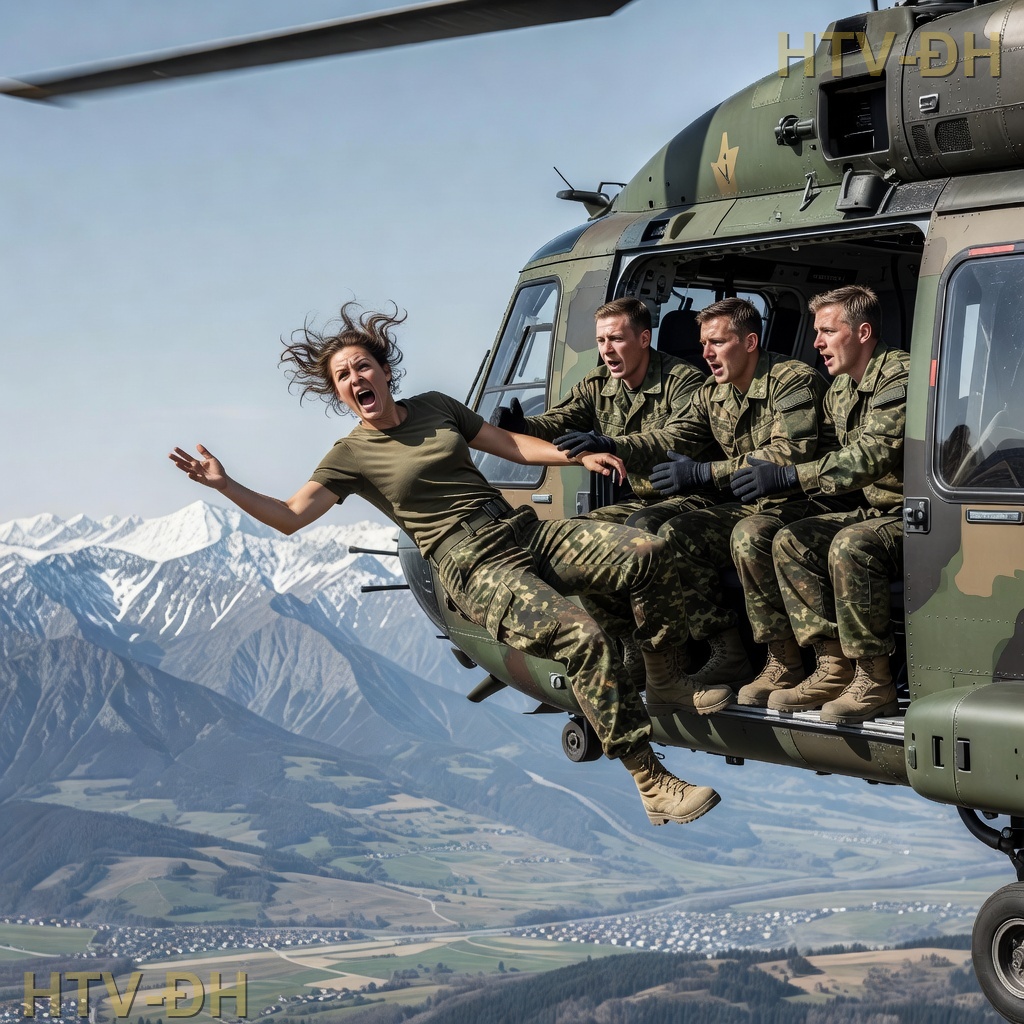
They Threw Her From a Helicopter at 12,000 Feet—Then She Walked Back With the Evidence That Destroyed Them.
They didn’t push me out because the helicopter was going down.
They pushed me out because I knew who sold our mission.
At twelve thousand feet over a frozen Afghan ridge, Captain Whitaker smiled, cut my safety line, and said, “Rangers die every day, Reynolds.”
He forgot one thing.
Rangers come back.
PART 1 — THE FALL
The man who threw me from the helicopter saluted my empty seat before I hit the mountain.
Captain Drew Whitaker did it with two fingers.
Casual.
Like he was ordering a black coffee at a gas station off I-95.
One second I was strapped inside a Black Hawk, rain hammering the fuselage, rotors beating the storm into pieces.
The next second his gloved hand slid across my harness buckle.
Click.
Not loud.
Not dramatic.
Just a small metal sound under the roar of the blades.
Enough to change a life.
I looked down.
My chest strap hung loose.
Whitaker leaned close enough for me to smell spearmint gum and stale coffee on his breath.
“Should’ve kept your mouth shut, Hawk.”
Then his boot hit my vest.
I went out backward into the storm.
No heroic music.
No slow-motion movie crap.
Just wind punching the air from my lungs and the helicopter shrinking above me like a bad decision.
Rain slapped my face.
My rifle strap whipped across my jaw.
The mountains under me looked black, jagged, and extremely interested in killing me.
I had maybe six seconds.
Maybe less.
Plenty of time to get angry.
Whitaker had been dirty. I knew it before the mission briefing, before the fake intel packet, before the weird way he kept checking his satellite phone like a nervous teenager waiting for a prom date to text back.
I had caught the irregularities.
Wrong extraction coordinates.
Changed flight path.
An informant who suddenly knew too much.
And then, last night, I saw the wire transfer.
Two hundred thousand dollars routed through a shell security company registered in Delaware.
Whitaker’s signature on one side.
A private defense contractor on the other.
Men like him never sell their country in one dramatic moment.
They do it in small, convenient steps.
A favor.
A missing report.
A patrol sent fifteen minutes too late.
A helicopter routed over hostile ground during bad weather.
And when somebody notices, that somebody has an accident.
Tonight, I was the accident.
The wind spun me sideways.
Training took over before panic could clock in.
Chin down.
Arms in.
Find the slope.
Do not land flat.
Do not tense.
Do not waste the final seconds being impressed by gravity.
Below me, the ridge tore through the fog.
Loose shale.
Snow patches.
A narrow chute between two rock shelves.
Terrible place to land.
Better than the cliff face.
I twisted hard, felt something rip in my shoulder, and aimed my body toward the slope.
Impact didn’t feel like pain at first.
It felt like being unplugged.
Then everything came back at once.
Rock punched my ribs.
My helmet cracked against stone.
My left arm folded wrong under me.
I rolled, hit again, slid, bounced, and slammed through scrub brush that clawed at my uniform.
My mouth filled with dirt.
The world turned gray, black, white, gray again.
Finally, I crashed into a shallow ravine and stopped face down in mud so cold it felt engineered by somebody who hated comfort.
For three seconds, I did nothing.
Not because I was calm.
Because my body was running a systems check and most departments were reporting damage.
I spit out mud.
Then I laughed once.
Small.
Ugly.
Private.
Still alive, Captain.
Not your best work.
Above me, the helicopter fought the storm.
Then came the explosion.
A flash bloomed behind the clouds.
The Black Hawk didn’t go down right away. Birds like that are built by people who respect physics and hate failure.
But the tail swung wild.
The pilot fought it.
The aircraft dipped behind the ridge.
Then the sound came.
Metal tearing.
Fire breathing.
Men shouting over comms I could no longer hear.
I rolled onto my back and stared up at the rain.
My left side burned.
My ribs felt like someone had taken a Louisville Slugger to them for fun.
My radio was cracked.
My GPS screen was dead.
My rifle was gone.
Sidearm still holstered.
Knife still there.
Two magazines.
One compression bandage.
Half a canteen.
A busted flare.
A packet of electrolyte powder because some supply officer somewhere believed in optimism.
Good enough.
I pushed myself upright and nearly blacked out.
That annoyed me.
So I stayed awake out of spite.
The ravine was narrow, steep, and hidden under a shelf of rock. If enemy patrols swept the area, they might miss me unless I did something stupid like bleed brightly or breathe loudly.
I checked my arm.
Not cleanly broken.
Bad sprain or hairline fracture.
Usable if I hated myself enough.
I hated Whitaker more.
That helped.
My harness buckle hung from my vest.
I pulled it close and saw the cut.
Not torn.
Cut.
Clean slice through the retention strap.
Military-grade webbing doesn’t fail like a cheap Walmart backpack.
Someone had used a blade.
Someone who knew exactly where to cut.
I took the damaged strap, folded it, and shoved it into my inner pocket.
Evidence.
A stupid word to think about while lying in a mountain ravine behind enemy lines.
But I was still American enough to believe paperwork could ruin a criminal faster than a bullet.
The storm muted everything.
Gunfire popped somewhere east.
The crash site burned somewhere above.
My team would think I was dead.
Command would mark me KIA.
Whitaker would mourn me in front of everyone, probably with that careful face officers use when they want cameras nearby.
He would call me brave.
He would call my death tragic.
He would call the mission compromised and redirect blame toward weather, insurgents, mechanical failure, bad luck, maybe God if he got creative.
I stood.
My knees buckled.
I grabbed the rock wall and breathed through my teeth.
No drama.
Just inventory.
Move.
Hide.
Water.
Assess enemy.
Find team.
Expose traitor.
Do not die before making him regret his haircut.
The first patrol came twenty minutes later.
Three men moving fast through the rain, rifles up, boots slipping on the stone. They spoke quietly, not English. One held a radio. One had a flashlight covered in red film. One kept looking uphill toward the crash.
They were searching for survivors.
Not rescuing.
Searching.
I pressed myself under the rock shelf, mud soaking my sleeves, knife in my right hand.
The lead man stopped two yards from me.
His light passed over the ravine.
Once.
Twice.
My lungs demanded air.
I told them no.
He stepped closer.
A drop of my blood fell from my sleeve onto a pale stone.
He saw it.
His head turned.
I moved first.
I didn’t fight fair.
Fair is for bowling leagues and divorce court.
I pulled him down hard, drove my elbow into his throat, caught his radio before it hit stone, and dragged him into shadow.
The second man turned.
Too late.
I used the first man’s body as cover, took his sidearm, fired once into the dirt near the third man, and let the echo bounce wild through the ravine.
Panic did the rest.
The third man shouted, stumbled backward, and fired blind at shadows that weren’t me.
Rocks shattered above my head.
I crawled under the ledge, waited for him to reload, then threw a stone down the opposite slope.
He fired toward it.
I was already moving.
By the time they figured out the mountain hadn’t shot back, I had their radio, one extra magazine, and a direction.
East.
That’s where their voices kept pointing.
East was where my team had been flying.
East was where Whitaker would lead them into a box.
The radio crackled.
I caught one English phrase through static.
“Package secured.”
Not informant.
Package.
That confirmed it.
The mission was never a rescue.
It was a delivery.
My unit was the product.
Whitaker hadn’t just sold coordinates.
He had sold us.
I climbed through rain and loose rock until my fingers split inside my gloves.
Every step hurt.
Every breath had sharp edges.
Good.
Pain keeps receipts.
By dawn, I found a shallow cave above a frozen stream.
I cleaned the cuts with water that tasted like old pennies, wrapped my ribs tight, and used the dead radio battery casing to scrape mud off the stolen comms unit.
It worked in short bursts.
Enough to listen.
Not enough to transmit.
I heard Whitaker before sunrise.
His voice came through clean for four seconds.
“Reynolds is gone. Continue movement. No deviation.”
Gone.
Not missing.
Not presumed down.
Gone.
He knew exactly what he had done.
I leaned against the cave wall, looked at the gray morning spilling over the ridge, and smiled.
“Not gone,” I said.
My voice sounded rough.
Mean.
Alive.
“Just inconvenient.”
————————————————————————————————————————
They didn’t push me out because the helicopter was going down.
They pushed me out because I knew who sold our mission.
At twelve thousand feet over a frozen Afghan ridge, Captain Whitaker smiled, cut my safety line, and said, “Rangers die every day, Reynolds.”
He forgot one thing.
Rangers come back.
PART 1 — THE FALL
The man who threw me from the helicopter saluted my empty seat before I hit the mountain.
Captain Drew Whitaker did it with two fingers.
Casual.
Like he was ordering a black coffee at a gas station off I-95.
One second I was strapped inside a Black Hawk, rain hammering the fuselage, rotors beating the storm into pieces.
The next second his gloved hand slid across my harness buckle.
Click.
Not loud.
Not dramatic.
Just a small metal sound under the roar of the blades.
Enough to change a life.
I looked down.
My chest strap hung loose.
Whitaker leaned close enough for me to smell spearmint gum and stale coffee on his breath.
“Should’ve kept your mouth shut, Hawk.”
Then his boot hit my vest.
I went out backward into the storm.
No heroic music.
No slow-motion movie crap.
Just wind punching the air from my lungs and the helicopter shrinking above me like a bad decision.
Rain slapped my face.
My rifle strap whipped across my jaw.
The mountains under me looked black, jagged, and extremely interested in killing me.
I had maybe six seconds.
Maybe less.
Plenty of time to get angry.
Whitaker had been dirty. I knew it before the mission briefing, before the fake intel packet, before the weird way he kept checking his satellite phone like a nervous teenager waiting for a prom date to text back.
I had caught the irregularities.
Wrong extraction coordinates.
Changed flight path.
An informant who suddenly knew too much.
And then, last night, I saw the wire transfer.
Two hundred thousand dollars routed through a shell security company registered in Delaware.
Whitaker’s signature on one side.
A private defense contractor on the other.
Men like him never sell their country in one dramatic moment.
They do it in small, convenient steps.
A favor.
A missing report.
A patrol sent fifteen minutes too late.
A helicopter routed over hostile ground during bad weather.
And when somebody notices, that somebody has an accident.
Tonight, I was the accident.
The wind spun me sideways.
Training took over before panic could clock in.
Chin down.
Arms in.
Find the slope.
Do not land flat.
Do not tense.
Do not waste the final seconds being impressed by gravity.
Below me, the ridge tore through the fog.
Loose shale.
Snow patches.
A narrow chute between two rock shelves.
Terrible place to land.
Better than the cliff face.
I twisted hard, felt something rip in my shoulder, and aimed my body toward the slope.
Impact didn’t feel like pain at first.
It felt like being unplugged.
Then everything came back at once.
Rock punched my ribs.
My helmet cracked against stone.
My left arm folded wrong under me.
I rolled, hit again, slid, bounced, and slammed through scrub brush that clawed at my uniform.
My mouth filled with dirt.
The world turned gray, black, white, gray again.
Finally, I crashed into a shallow ravine and stopped face down in mud so cold it felt engineered by somebody who hated comfort.
For three seconds, I did nothing.
Not because I was calm.
Because my body was running a systems check and most departments were reporting damage.
I spit out mud.
Then I laughed once.
Small.
Ugly.
Private.
Still alive, Captain.
Not your best work.
Above me, the helicopter fought the storm.
Then came the explosion.
A flash bloomed behind the clouds.
The Black Hawk didn’t go down right away. Birds like that are built by people who respect physics and hate failure.
But the tail swung wild.
The pilot fought it.
The aircraft dipped behind the ridge.
Then the sound came.
Metal tearing.
Fire breathing.
Men shouting over comms I could no longer hear.
I rolled onto my back and stared up at the rain.
My left side burned.
My ribs felt like someone had taken a Louisville Slugger to them for fun.
My radio was cracked.
My GPS screen was dead.
My rifle was gone.
Sidearm still holstered.
Knife still there.
Two magazines.
One compression bandage.
Half a canteen.
A busted flare.
A packet of electrolyte powder because some supply officer somewhere believed in optimism.
Good enough.
I pushed myself upright and nearly blacked out.
That annoyed me.
So I stayed awake out of spite.
The ravine was narrow, steep, and hidden under a shelf of rock. If enemy patrols swept the area, they might miss me unless I did something stupid like bleed brightly or breathe loudly.
I checked my arm.
Not cleanly broken.
Bad sprain or hairline fracture.
Usable if I hated myself enough.
I hated Whitaker more.
That helped.
My harness buckle hung from my vest.
I pulled it close and saw the cut.
Not torn.
Cut.
Clean slice through the retention strap.
Military-grade webbing doesn’t fail like a cheap Walmart backpack.
Someone had used a blade.
Someone who knew exactly where to cut.
I took the damaged strap, folded it, and shoved it into my inner pocket.
Evidence.
A stupid word to think about while lying in a mountain ravine behind enemy lines.
But I was still American enough to believe paperwork could ruin a criminal faster than a bullet.
The storm muted everything.
Gunfire popped somewhere east.
The crash site burned somewhere above.
My team would think I was dead.
Command would mark me KIA.
Whitaker would mourn me in front of everyone, probably with that careful face officers use when they want cameras nearby.
He would call me brave.
He would call my death tragic.
He would call the mission compromised and redirect blame toward weather, insurgents, mechanical failure, bad luck, maybe God if he got creative.
I stood.
My knees buckled.
I grabbed the rock wall and breathed through my teeth.
No drama.
Just inventory.
Move.
Hide.
Water.
Assess enemy.
Find team.
Expose traitor.
Do not die before making him regret his haircut.
The first patrol came twenty minutes later.
Three men moving fast through the rain, rifles up, boots slipping on the stone. They spoke quietly, not English. One held a radio. One had a flashlight covered in red film. One kept looking uphill toward the crash.
They were searching for survivors.
Not rescuing.
Searching.
I pressed myself under the rock shelf, mud soaking my sleeves, knife in my right hand.
The lead man stopped two yards from me.
His light passed over the ravine.
Once.
Twice.
My lungs demanded air.
I told them no.
He stepped closer.
A drop of my blood fell from my sleeve onto a pale stone.
He saw it.
His head turned.
I moved first.
I didn’t fight fair.
Fair is for bowling leagues and divorce court.
I pulled him down hard, drove my elbow into his throat, caught his radio before it hit stone, and dragged him into shadow.
The second man turned.
Too late.
I used the first man’s body as cover, took his sidearm, fired once into the dirt near the third man, and let the echo bounce wild through the ravine.
Panic did the rest.
The third man shouted, stumbled backward, and fired blind at shadows that weren’t me.
Rocks shattered above my head.
I crawled under the ledge, waited for him to reload, then threw a stone down the opposite slope.
He fired toward it.
I was already moving.
By the time they figured out the mountain hadn’t shot back, I had their radio, one extra magazine, and a direction.
East.
That’s where their voices kept pointing.
East was where my team had been flying.
East was where Whitaker would lead them into a box.
The radio crackled.
I caught one English phrase through static.
“Package secured.”
Not informant.
Package.
That confirmed it.
The mission was never a rescue.
It was a delivery.
My unit was the product.
Whitaker hadn’t just sold coordinates.
He had sold us.
I climbed through rain and loose rock until my fingers split inside my gloves.
Every step hurt.
Every breath had sharp edges.
Good.
Pain keeps receipts.
By dawn, I found a shallow cave above a frozen stream.
I cleaned the cuts with water that tasted like old pennies, wrapped my ribs tight, and used the dead radio battery casing to scrape mud off the stolen comms unit.
It worked in short bursts.
Enough to listen.
Not enough to transmit.
I heard Whitaker before sunrise.
His voice came through clean for four seconds.
“Reynolds is gone. Continue movement. No deviation.”
Gone.
Not missing.
Not presumed down.
Gone.
He knew exactly what he had done.
I leaned against the cave wall, looked at the gray morning spilling over the ridge, and smiled.
“Not gone,” I said.
My voice sounded rough.
Mean.
Alive.
“Just inconvenient.”
PART 2 — THE WOMAN THEY MISREAD
Before Whitaker tried to kill me, half the men in Ranger School tried to quit on my behalf.
They were very generous that way.
Day one, Fort Benning smelled like wet grass, boot polish, cheap coffee, and male confidence.
A guy from Texas looked me up and down while we waited outside the barracks.
“You lost, ma’am?”
I checked my watch.
“No. But your chin strap’s upside down.”
His buddy laughed.
He didn’t.
By week two, nobody was laughing much.
Ranger School doesn’t care what you believe about yourself.
It takes your beliefs, throws them into Georgia mud, starves them, freezes them, and asks what’s left.
I learned fast.
Men talked.
Mud didn’t.
Cold didn’t.
Forty-eight hours without sleep didn’t care whether I had eyeliner in my locker or a uterus under my uniform.
During a twenty-mile ruck, somebody swapped my boots for a pair half a size too small.
Cute.
My heels opened by mile six.
By mile eleven, every step left blood in my socks.
By mile twenty, the guy who had laughed at me on day one collapsed twenty yards from the finish.
I could have stepped over him.
I didn’t.
I grabbed his ruck, dragged him upright, and said, “Move, princess. I’m not carrying your ego and your gear.”
He moved.
Later, he thanked me.
I told him to fix his chin strap.
That was the first lesson they learned about me.
I didn’t need them to like me.
I needed them to keep up.
The instructors noticed.
One of them, Sergeant Major Harlan, had a face like carved oak and the bedside manner of a tax audit.
He watched me shoot in crosswind during a field exercise.
Five targets.
Rain in my eyes.
Hands numb.
Five hits.
He stared through his binoculars and said, “Reynolds doesn’t quit. She recalculates.”
The nickname came after that.
Hawk.
Not because I was graceful.
Because I watched everything.
Boot prints.
Breathing patterns.
Who lied badly.
Who smiled when other people failed.
Men like Whitaker.
Back then, I didn’t know his name.
But Ranger School taught me his type before I ever met him.
Clean uniform.
Dirty hands.
Polished speeches.
Soft ethics.
The kind of officer who says “team” when he means “shield.”
By graduation, I had stopped proving I belonged.
That’s the trick.
The second you spend your life asking permission to stand in the room, someone like Whitaker starts charging rent.
I earned my tab.
I earned my call sign.
I earned the right to walk into hell without asking whether hell was comfortable with women.
So when Whitaker cut my harness over Thunder Ridge, he made one fatal miscalculation.
He thought he was removing a problem.
He was creating one with training.
PART 3 — THE GHOST IN THE VALLEY
By the third night, enemy patrols were whispering about an American ghost stealing their supplies.
They were half right.
I was American.
I was stealing.
Ghost was generous.
Ghosts probably don’t smell like dried blood, smoke, and wet socks.
The valley below Thunder Ridge had a local name I couldn’t pronounce and a reputation even our interpreters treated with respect.
The men on base called it the Bone Bowl.
Not official.
Nothing poetic.
Just a bowl-shaped stretch of cliffs, ravines, abandoned goat trails, and old Soviet-era debris where radios failed and bad decisions went to retire.
I moved through it one yard at a time.
Never straight.
Never fast.
Fast gets you noticed.
Straight gets you buried.
I drank through a strip of torn sleeve.
I ate dry grain from a cracked plastic bucket I found in an abandoned shepherd hut.
I reset my arm with my boot braced against a rock and a curse word that would have embarrassed my grandmother if she hadn’t been from Detroit.
Every morning, I listened.
Every afternoon, I watched.
Every night, I moved.
The stolen radio gave me pieces.
Whitaker was alive.
My team was alive.
The informant was dead.
Not killed in the firefight.
Dead before we arrived.
Which meant the entire extraction order had been fake from the start.
I caught fragments from enemy chatter.
“Americans trapped near east pass.”
“Captain confirmed.”
“Payment after transfer.”
Captain.
Confirmed.
There it was.
Whitaker wasn’t just leaking information.
He was coordinating in real time.
That required a device.
A sat phone, probably encrypted, probably hidden in his ruck or inside the med kit he never let anyone touch.
I needed proof.
Not suspicion.
Not battlefield gossip.
Proof.
America loves heroes until paperwork gets messy.
Then everyone suddenly develops memory problems.
On day four, I found the first abandoned cache.
A tarp under rocks.
Water.
Bandages.
Two cans of peaches with labels faded almost white.
A cheap burner phone wrapped in plastic.
I checked it.
No signal.
But the call log had numbers.
International prefixes.
Recent.
I took the SIM card and left the phone cracked under a rock where anyone would assume weather killed it.
I also took the peaches.
I’m patriotic, not stupid.
The first bite tasted like a Fourth of July picnic hosted by God.
I allowed myself three spoonfuls.
Then I sealed the rest.
Discipline is mostly telling your body to shut up while your brain does math.
That night, I got close enough to see my team.
They were pinned near an old stone compound east of the ridge, using boulders and broken walls for cover. Seven Rangers left.
Jenkins.
Morales.
Diaz.
O’Rourke.
Baker.
Sims.
Whitaker.
Seeing him alive irritated me.
Seeing him standing behind everyone else irritated me more.
Jenkins had a bandage around his thigh.
Morales was limping.
Diaz kept checking ammo.
O’Rourke was arguing with Whitaker, which meant O’Rourke still had functioning instincts.
I crawled belly-down across frozen dirt until I reached a broken drainage ditch fifty yards from their position.
Close enough to hear.
Whitaker’s voice carried.
“We hold until dark, then we move south.”
Jenkins snapped back, “South is exposed.”
“South is our order.”
“From who?”
Whitaker paused.
Small pause.
Guilty pause.
“Command.”
O’Rourke laughed once.
“Command? Our comms have been trash since the crash.”
Whitaker turned on him.
“You want to take tactical advice from a staff sergeant with blood loss?”
O’Rourke stepped closer.
“I want to take advice from somebody who didn’t get us ambushed.”
That was when Whitaker lifted his rifle.
Not fully.
Just enough.
I had seen men do that before.
Threat without paperwork.
Jenkins saw it too.
His hand moved toward his sidearm.
The unit was cracking.
Good people under bad command can only hold so long before discipline becomes a cage.
I needed to reach them before Whitaker led them into the kill zone.
But the enemy had the compound watched from three sides.
Two machine gun nests.
One sniper position on the western shelf.
A comms relay under a canvas cover near the dry creek bed.
Four patrols rotating every twenty minutes.
Not impossible.
Just rude.
I backed out before dawn and spent the next day setting the valley against them.
First, the relay.
I waited until wind picked up grit from the canyon floor, then crawled under the cover of dust. The guard was young. Too young. He held his rifle like it was heavier than his confidence.
I didn’t kill him.
I knocked him out with a rock wrapped in cloth and dragged him behind a supply crate.
Then I opened the relay box and used my knife to slice three wires in a pattern that looked like rodent damage.
Always give people a boring explanation.
Boring survives investigation.
Next, the western shelf.
The sniper had a good position, good sightline, bad habit.
Every seven minutes, he reached into his jacket for sunflower seeds.
I watched him do it six times.
On the seventh, I used a mirror shard to flash light toward the opposite ridge.
He turned.
I fired one round into his scope.
The glass shattered.
He threw himself backward, shouting.
Now he had no scope, no dignity, and a story nobody would enjoy hearing.
Then I moved.
Rocks became alarms.
Branches became false trails.
A burning strip of cloth inside an old fuel can made smoke rise from the wrong side of the valley.
By sunset, the enemy believed three separate American units had entered the area.
They shifted men away from my team.
Whitaker noticed.
He wasn’t dumb.
That was the annoying thing about traitors.
The best ones are competent.
He scanned the cliffs longer than the others.
His jaw tightened.
He knew something was wrong.
Good.
I wanted him nervous.
Nervous men make visible mistakes.
At midnight, I approached the compound.
Jenkins saw me first.
He had his rifle up before I could blink.
Then his face changed.
Not soft.
Not emotional.
Just stunned enough to forget the pain in his leg.
“Reynolds?”
I pressed a finger to my lips.
Morales whispered, “Holy—”
“Quiet,” I said.
O’Rourke stared at me like I had walked out of a tax form marked deceased.
“You fell out of a helicopter.”
“Technically, I was pushed.”
Everyone looked at Whitaker.
Whitaker looked at me.
For one clean second, his officer mask slipped.
Fear.
Then anger.
Then calculation.
He recovered fast.
“Sergeant Reynolds,” he said. “You’re injured. You’re confused.”
I stepped closer.
Mud on my uniform.
Blood dried at my collar.
One sleeve cut away.
Stolen sidearm in my hand.
“No, sir. I’m annoyed.”
Jenkins didn’t lower his rifle.
“Pushed?”
Whitaker barked, “We do not have time for conspiracy garbage.”
I pulled the cut harness strap from my pocket and tossed it at his boots.
It landed in the dirt between us.
The slice was clean under moonlight.
Nobody spoke.
I looked at Jenkins.
“He cut my line. Routed us into an ambush. Your south exit is a trap. They’re waiting at the pass.”
Whitaker laughed.
Too loud.
“Listen to yourself. You’re hypothermic and running on adrenaline.”
“Maybe,” I said. “But I still know the difference between a frayed strap and a knife cut.”
Diaz picked it up, examined it, and looked at Whitaker.
His expression did the work.
Whitaker shifted his weight.
Tiny movement.
Right hand toward his vest.
Not rifle.
Vest.
Sat phone.
I moved before he got there.
My pistol came up.
“Don’t.”
His smile thinned.
“You’re pointing a weapon at a superior officer.”
“And you’re sweating in twenty-eight-degree weather.”
O’Rourke snorted.
“Fair observation.”
Whitaker’s eyes flicked toward the south pass.
Then toward the enemy lines.
Then back to me.
He was calculating whether he could run, shoot, lie, or order someone else to do something stupid.
That’s when the first flare went up.
Red light washed the compound.
Enemy voices erupted from the ridge.
Whitaker had stalled long enough.
They were coming.
He smiled.
Small.
Satisfied.
“Congratulations, Reynolds,” he said. “You found me. Now what?”
I checked my magazine.
Then looked at my team.
“Now we leave.”
Jenkins grabbed his rifle.
“North?”
“North gets us shot,” I said. “South gets us sold. West gets us trapped.”
Morales winced. “East?”
I pointed toward the cliff behind us.
“Down.”
Baker stared over the edge.
“That’s a goat trail.”
“Great,” I said. “Try to be goat-adjacent.”
Whitaker snapped, “No one moves without my order.”
Nobody moved.
Not for him.
For me.
That silence hit harder than any punch.
His command was dead.
He just hadn’t received the memo.
I looked at Jenkins.
“You good?”
He tightened the bandage on his thigh.
“No.”
“Can you move?”
“Absolutely.”
“That’s the spirit.”
The enemy opened fire.
Rounds cracked into stone.
Dust kicked up around us.
I pulled a smoke grenade from Diaz’s vest, popped it, and threw it toward the south pass.
Then I fired twice toward the western shelf, not to hit, just to make them duck.
“Move!”
We dropped over the cliff one by one.
The goat trail was barely a trail.
More like a suggestion made by an animal with poor risk assessment.
Jenkins slid twice.
Morales nearly went over.
O’Rourke caught him by the vest and said, “Buy me dinner before you get dramatic.”
Behind us, Whitaker followed because cowards hate being left without witnesses.
The enemy pushed toward the compound.
Their south ambush waited for us in the wrong place.
My smoke drew them lower.
My false trails drew them west.
The broken relay kept them shouting into dead radios.
For ten minutes, we owned the valley.
Then Whitaker made his move.
Halfway down the trail, he grabbed Sims and shoved him aside, trying to force past.
Sims slipped.
I caught his wrist.
Pain tore through my ribs so hard my vision sparked.
O’Rourke grabbed Sims’s belt and hauled him back.
Whitaker kept moving.
“Stop him!” Jenkins shouted.
Whitaker looked back once.
No apology.
No shame.
Just panic in expensive boots.
Then he ran toward the lower ravine.
Straight into the path I had already marked as dangerous.
The ground gave under his left foot.
He dropped hard, slid fifteen feet, and slammed into a rock shelf.
His rifle vanished into the dark.
His sat phone skidded free from his vest and bounced across the trail.
I stepped on it before he could crawl toward it.
Whitaker looked up.
For the first time since I had known him, he didn’t have a speech ready.
I picked up the phone.
Locked.
Biometric.
I grabbed his wrist and pressed his thumb to the screen.
It opened.
Messages loaded.
Coordinates.
Payment confirmations.
Our flight path.
My name.
REYNOLDS SUSPECTS. REMOVE IF NECESSARY.
Jenkins read over my shoulder.
His face went flat.
Military-flat.
The kind of calm that gets people court-martialed later if no one supervises it.
Whitaker swallowed.
“Jenkins—”
Jenkins hit him once.
Not wild.
Not emotional.
Just a clean right hand that knocked Whitaker’s head back against the rock.
“Oops,” O’Rourke said. “Terrain.”
I took zip ties from Baker’s kit and bound Whitaker’s wrists.
He groaned.
“You need me. I’m the ranking officer.”
I tightened the zip tie.
“No. You’re cargo.”
Then the extraction helicopter appeared beyond the ridge, its lights low, rotors cutting through the dark.
A real rescue.
Not Whitaker’s trap.
I had triggered the emergency beacon from the stolen radio battery and rerouted it through the broken relay before I left.
It wasn’t elegant.
It was ugly, unstable, and held together by theft and spite.
But it worked.
American rotors sounded different when they came for you.
The team moved faster now.
Not because they weren’t hurt.
Because hope is a stimulant nobody regulates.
We reached the extraction zone under fire.
I climbed to a ledge above the clearing and covered the team as they loaded.
Jenkins went last before me.
He looked up.
“Reynolds!”
“I’m coming.”
Then I saw Whitaker crawling toward the edge of the landing zone.
Still trying to run.
Still convinced rules were something other people tripped over.
I walked over, grabbed the back of his vest, and dragged him across the gravel toward the helicopter.
He screamed about his shoulder.
I leaned close.
“You threw me out of an aircraft, Captain. This is curbside service.”
We lifted off under fire.
No speeches.
No swelling music.
Just exhausted men strapped into seats, one traitor zip-tied on the floor, and me holding a sat phone with enough evidence to end a career, a pension, and maybe a marriage.
Whitaker stared at me from the floor.
“You don’t know how this works,” he said.
I looked out at the mountains.
Then back at him.
“I know exactly how this works.”
The helicopter banked west toward base.
“And I brought receipts.”
PART 4 — THE DEBRIEF
The first thing Whitaker did back on base was ask for a lawyer before anyone offered him water.
That was helpful.
Innocent men ask about their team.
Guilty men ask about liability.
The medics tried to take me straight to trauma.
I refused until they took the sat phone, the cut harness, the stolen SIM card, and the radio logs into evidence with three witnesses watching.
The major in charge of intake looked offended.
“Sergeant, you need medical attention.”
“I need a chain of custody.”
“You have fractured ribs.”
“And a functioning memory.”
Jenkins, sitting on a stretcher with his thigh wrapped tight, raised one hand.
“I’ll witness.”
O’Rourke raised his.
“Same. Also, for the record, Captain Whitaker fell because the terrain lacked respect for corruption.”
The major stared at him.
O’Rourke shrugged.
“I’m concussed. Probably poetic.”
CID arrived twenty minutes later.
Two agents.
One woman with a tight bun and eyes that missed nothing.
One man carrying a laptop and the dead expression of somebody who had spent too much time reading military emails.
Agent Marlowe took the sat phone first.
She didn’t ask me for the story right away.
Smart.
Stories bend when adrenaline is still driving.
Data doesn’t.
She plugged the phone into a forensic kit while medics cut my sleeve open.
The doctor examined my ribs and said, “You should be unconscious.”
“Put it on my evaluation.”
He didn’t laugh.
Doctors in combat zones are hard to impress.
By 0400, the first files opened.
Coordinates.
Encrypted texts.
A payment ledger.
Names of three private contractors.
One Afghan intermediary.
One American defense consultant in Virginia who had apparently confused patriotism with invoice management.
And Captain Drew Whitaker, photographed two months earlier in Dubai shaking hands with a man on a Treasury watch list.
Agent Marlowe looked at the screen.
Then at Whitaker through the glass of the holding room.
He was sitting with a blanket around his shoulders, trying to look injured enough to be sympathetic and alert enough to control the room.
It was a difficult balance.
He failed.
Marlowe turned to me.
“Sergeant Reynolds, did Captain Whitaker knowingly compromise your mission?”
I sat on the exam table while a medic taped my ribs.
“He sold the route, altered the extraction plan, sabotaged my harness, pushed me from the aircraft, attempted to lead the surviving unit into a prepared ambush, then tried to flee with an encrypted device containing evidence.”
The room went still.
O’Rourke, from the next bed, called out, “Don’t forget he’s bad at running downhill.”
Marlowe typed.
“I’ll include that under tactical limitations.”
By sunrise, Whitaker’s life began coming apart with impressive efficiency.
His command access was revoked.
His weapon was seized.
His bank accounts were flagged.
His wife was notified by legal liaison because certain benefits freeze when your husband is accused of treason-related offenses.
That part hit him hardest.
Not the dead informant.
Not the ambush.
Not my fall.
The money.
Men like him always think betrayal is business until accounting gets involved.
At 0900, Colonel Briggs entered the debrief room.
He was old Army.
Square shoulders.
Silver hair.
Voice like gravel in a metal bucket.
He had promoted Whitaker two years earlier.
That made this personal.
Not emotional.
Personal.
There’s a difference.
He stood at the head of the table while I sat with an IV in my arm and a report packet in front of me.
Jenkins sat beside me.
Morales had one eye swollen half shut.
Diaz kept eating crackers from an MRE pouch like it owed him money.
Whitaker was brought in wearing zip-tie marks on his wrists and an expression built from legal advice.
His appointed counsel sat beside him.
The room smelled like burnt coffee, antiseptic, and consequences.
Colonel Briggs opened the file.
“Captain Whitaker, before we proceed, you should understand this is not a routine after-action review.”
Whitaker lifted his chin.
“I understand, sir.”
“No,” Briggs said. “You don’t.”
He clicked the remote.
The screen lit up.
Flight path.
Original route.
Altered route.
Enemy positions.
Payment transfer.
Message log.
REYNOLDS SUSPECTS. REMOVE IF NECESSARY.
Nobody moved.
Whitaker’s lawyer closed his eyes for half a second.
That told me the defense strategy had just died quietly in its sleep.
Briggs looked at Whitaker.
“Did you send this message?”
Whitaker stared at the screen.
“I won’t answer without counsel.”
“Wise,” Briggs said. “Late, but wise.”
Then Briggs turned to me.
“Sergeant Reynolds, walk us through the fall.”
So I did.
Not with drama.
Drama gives liars hiding places.
I used time stamps.
Positions.
Equipment details.
Wind direction.
Harness damage.
Whitaker’s proximity.
His words.
His boot against my vest.
The agents recorded everything.
Whitaker looked bored at first.
Then irritated.
Then pale when I described the cut angle in the strap and matched it to the blade type from his field knife.
CID had recovered it.
Cleaned recently.
Not clean enough.
Microscopic nylon fibers don’t care about rank.
When I finished, Briggs said nothing for a long time.
Then he removed his glasses.
“Captain Whitaker, you are relieved of duty pending charges under the Uniform Code of Military Justice. You will be held under guard. Your security clearance is suspended. Your command is terminated immediately.”
Whitaker stood so fast his chair scraped the floor.
“This is insane.”
Briggs didn’t raise his voice.
“You sold soldiers.”
“I made strategic decisions under pressure.”
“You took money.”
“That’s not what it looks like.”
O’Rourke muttered, “It looks like Venmo for treason.”
The lawyer whispered sharply, “Stop talking.”
Whitaker ignored him.
He looked at me.
“You think you’re a hero now? You think they’ll protect you? They’ll use your story for recruiting posters, then bury the ugly parts.”
I leaned back carefully because my ribs had filed complaints.
“Maybe.”
That surprised him.
I continued.
“But you won’t be buried. You’ll be documented.”
His jaw worked.
No comeback.
Documentation is the language of permanent damage.
By noon, the story had left the room.
Not officially.
Officially, nothing leaves a military base until public affairs has polished it smooth enough to blind people.
Unofficially, soldiers talk.
Medics talk.
Pilots talk.
The cook who handed me real scrambled eggs instead of powdered ones said, “Heard you fell out of the sky and arrested your captain.”
“Dragged,” I corrected.
“Even better.”
By evening, Whitaker’s name was poison.
Not loud poison.
Quiet poison.
The kind that makes men step away from you in the chow hall.
The kind that gets your calls unanswered.
The kind that makes every handshake in your past look suspicious.
His contractor friends got raided within forty-eight hours.
One resigned.
One fled to Canada and was detained at the border because apparently panic makes people forget passports have databases attached.
The consultant in Virginia had his home office searched by federal agents while his neighbor filmed from behind a hydrangea bush.
America has many flaws.
But it does enjoy watching a rich man meet a subpoena.
I spent three days in medical.
Fractured ribs.
Deep tissue bruising.
Concussion.
Lacerations.
Shoulder strain.
Minor hypothermia.
A doctor told me I was lucky.
I asked him to define luck.
He said, “Alive.”
Fair.
On the fourth day, Jenkins came in with a cardboard tray of Starbucks from the tiny base café that charged Pentagon prices for airport-quality coffee.
He handed me a cup.
“Black. Like your personality.”
I took it.
“Thanks. How’s the leg?”
“Annoyed but attached.”
“Good review.”
He sat in the chair beside my bed.
For a while, neither of us said anything.
That’s friendship in uniform.
Silence without discomfort.
Then he said, “We believed him.”
I knew who he meant.
Whitaker.
I took a sip.
The coffee was terrible.
Beautifully terrible.
“You were in a kill box with bad comms and wounded men. Believing the ranking officer isn’t a character flaw.”
Jenkins stared at the floor.
“He sold us.”
“Yeah.”
“You saved us.”
“I was already in the neighborhood.”
He huffed once.
Almost a laugh.
Then his face hardened.
“When this goes public, they’ll make it about survival.”
“Probably.”
“But it was betrayal.”
“Yes.”
He looked at me.
“You okay with that part getting buried?”
I set the cup down.
“No.”
The next morning, Agent Marlowe returned with two federal investigators and a public affairs officer who looked like she had slept in a printer.
Marlowe handed me a tablet.
“Your official statement for review.”
I read it.
It used phrases like “mission irregularities,” “equipment failure,” and “adverse operational conditions.”
It did not use “Captain cut my harness and pushed me out of a helicopter because I caught him selling us.”
I looked at the public affairs officer.
She looked tired before I even started.
“No,” I said.
She sighed.
“Sergeant Reynolds, ongoing investigations require careful language.”
“Careful is fine. Cowardly is not.”
Marlowe’s mouth twitched.
The officer folded her hands.
“We need to protect operational integrity.”
“You need to protect institutional comfort.”
That landed.
Nobody spoke.
I slid the tablet back.
“Try again.”
To her credit, she did.
The second version still wore a suit, but at least it told the truth with its shoes on.
It confirmed sabotage.
Confirmed arrest.
Confirmed attempted compromise of U.S. personnel.
Confirmed that surviving Rangers provided sworn statements.
Confirmed that evidence had been turned over to federal authorities.
Whitaker would not be hidden behind fog and mountain weather.
Not this time.
Two weeks later, I walked into the formal hearing in dress uniform because painkillers and stubbornness make excellent tailors.
Whitaker sat at the defense table.
Clean-shaven.
Paler.
Thinner.
No rank insignia.
That absence looked louder than medals.
His wife sat in the back row for the first ten minutes.
Then prosecutors played the message logs.
REYNOLDS SUSPECTS. REMOVE IF NECESSARY.
She stood, picked up her purse, and left without looking at him.
Whitaker watched her go.
For the first time, he looked truly afraid.
Not of prison.
Not of disgrace.
Of being seen accurately.
That is the one thing men like him cannot survive.
The hearing lasted six hours.
By the end, Whitaker had lost command, clearance, pension eligibility, contractor contacts, public sympathy, and the last scraps of the officer persona he had spent years polishing.
Charges moved forward.
Federal agencies widened the investigation.
His name became attached to words that do not wash off.
Bribery.
Conspiracy.
Attempted murder.
Treason-adjacent conduct, as one legal analyst put it carefully on cable news.
I preferred simpler language.
He sold us.
He got caught.
PART 5 — THE WALK OUT
When they asked me what I wanted after justice was served, I said, “A shower, a cheeseburger, and his name off my unit wall.”
I got all three.
The shower hurt.
The cheeseburger came from a diner outside Fort Benning with cracked red vinyl booths, bottomless coffee, and a waitress named Tammy who called every soldier “baby” regardless of rank.
Whitaker’s name came down on a Tuesday.
No ceremony.
No speech.
A staff sergeant climbed a ladder, unscrewed the plaque, and handed it to CID evidence control.
Perfect.
Men like Whitaker want dramatic exits.
Give them inventory processing.
Months later, I stood in front of a new Ranger class.
Some looked nervous.
Some looked arrogant.
A few looked at me like they had already heard the story and were trying not to stare at my scar.
I didn’t give them inspiration.
Inspiration fades by lunch.
I gave them facts.
“Your body will bargain with you. Your fear will lie to you. Bad leaders will test whether you obey louder than you think. Learn the difference between discipline and surrender.”
Nobody moved.
Good.
I pointed to the mountains on the training poster behind me.
“You may fall. You may be betrayed. You may be left for dead by someone who smiles at your memorial.”
I paused.
“Come back anyway.”
Afterward, Jenkins waited outside with two coffees.
“Black?” I asked.
He handed me one.
“Obviously.”
We walked past the flagpole into sharp Georgia sunlight.
My ribs still ached when it rained.
My shoulder clicked when I lifted too fast.
Whitaker was awaiting trial in a facility where nobody cared about his résumé.
My team was alive.
My name was not on a memorial wall.
That was enough.
Jenkins glanced at me.
“You ever think about what he said? That Rangers die every day?”
I sipped the coffee.
Still terrible.
Still perfect.
“He was right.”
Jenkins looked over.
I smiled.
“But some of us are really bad at staying dead.”
And I kept walking.